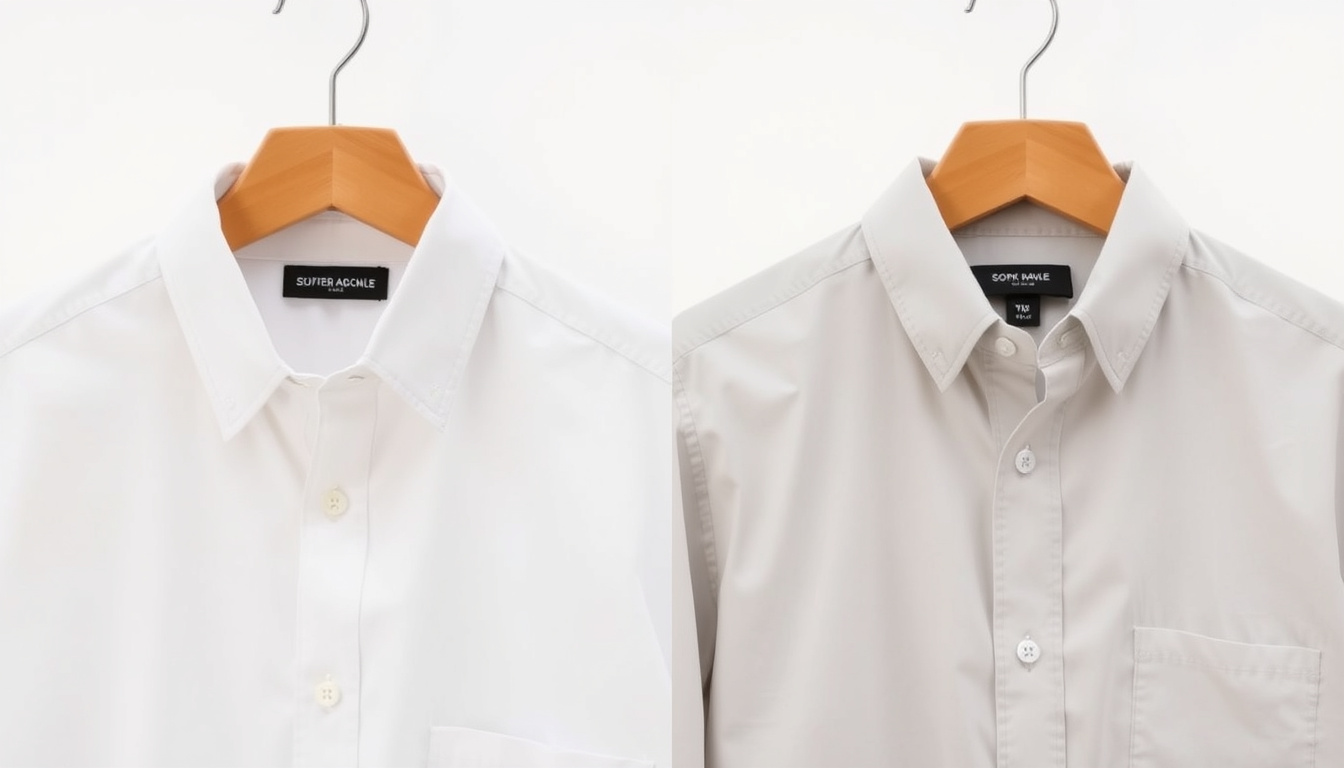
You’ve probably grabbed a shirt off a rack labeled “button-down” and assumed that’s the same thing as “button-up” — but the men’s fashion world has been quietly disagreeing for over a century. That small distinction between collar buttons and front buttons actually traces back to English polo fields and Ivy League campus lawns. Here’s how to tell them apart, which one suits different occasions, and where the terminology gets tangled.
Button-down collar introduced: 1896 by Brooks Brothers ·
Oxford shirt origin: Late 1800s at Oxford University ·
Button-up vs button-down key difference: Collar buttons vs full front buttons ·
Typical button-up shirt buttons: 6-8 front buttons
Quick snapshot
- A button-up shirt has a full front opening fastened with buttons (Wikipedia — Dress shirt)
- Button-down collars have small buttons on the collar points (Autostraddle — lifestyle and fashion publication)
- Exact origin of the term “button-up” is debated — no definitive first use has been documented (The TATTER Textile Library — textile history archive)
- Whether all Oxford shirts must have button-down collars is not universally agreed among clothiers (Taylor Stitch — heritage menswear brand)
- Brooks Brothers introduced the button-down collar in 1896 — but some sources contest the exact patent date (Blake Mill — menswear heritage publisher)
- Buttons used on Egyptian tunics by the 5th century AD (The TATTER Textile Library)
- Brooks Brothers patents the button-down collar in 1896 (Blake Mill) (The TATTER Textile Library)
- Button-down Oxford shirt becomes preppy icon in 1950s (Taylor Stitch) (The TATTER Textile Library)
- Sustainable fabrics and made-to-measure services are reshaping the button-up market (Taylor Stitch)
- Hybrid collar styles (button-down with spread collar) gaining popularity in 2020s
Six key facts, one pattern: the button-down collar was originally about function (keeping polo collars flat), while “button-up” is a purely descriptive term for any front-buttoning shirt — a distinction that still matters for dress codes today.
| Label | Value |
|---|---|
| First button-down collar | Introduced by Brooks Brothers in 1896 |
| Oxford shirt fabric | Cotton oxford cloth, first used late 19th century |
| Button-up shirt button count | Typically 6–8 front buttons |
| Most common collar styles | Spread, point, button-down, tab |
| Button-down vs button-up collar distinction | Button-down has buttons on collar points, button-up refers to full front button opening |
| Oxford cloth weave | Basket weave: two heavier warp threads over two finer weft threads (Taylor Stitch) |
| Button-down collar origin | Designed for English polo players to keep collars flat (Autostraddle) |
| Button-down vs formal perceptions | Button-down collar considered more casual due to sports origin (Autostraddle) |
| Dress shirt definition | Full front opening with buttons, collar, and long sleeves (Wikipedia) |
| Early button use on clothing | Buttons date to around 2000 BC at Mohenjo-daro (TATTER) |
| Button-down Ivy League association | Strong association with Ivy League style, especially Princeton (Blake Mill) |
| Reinforced buttonholes innovation | Reinforced buttonholes appeared by the 13th century (TATTER) |
What is a button-up shirt?
A button-up shirt is any shirt with a full-length opening down the front that’s fastened with buttons. That’s it — the term is purely descriptive and covers dress shirts, casual shirts, Oxford shirts, and even some short-sleeve shirts. The defining feature is the full front button placket, as distinct from pullovers or shirts with half-button fronts.
Definition and basic features
- Full front opening with 6-8 buttons running from collar to hem
- Collar (can be point, spread, button-down, tab, or wing)
- Cuffs with buttons or cufflinks (single-button cuffs are most common on casual and Oxford shirts, per Taylor Stitch — heritage menswear brand)
- Can be long-sleeve or short-sleeve; worn tucked or untucked depending on occasion
The term “button-up” is a straightforward American English descriptor — it contrasts with pullovers (sweaters, T-shirts, polo shirts) that lack a full front closure. The TATTER Textile Library notes that the broader category “button-front shirt” has existed for millennia, with early buttons found at Mohenjo-daro around 2000 BC.
Anyone shopping for a button-up today faces a surprising dilemma: the term is so broad it includes everything from a $4 thrift-store flannel to a $300 French-cuff dress shirt. The real value lies in understanding the sub-types — not the label on the tag.
Historical background
- Button closures on shirts date to the early Byzantine Empire (cuffs) and 5th century AD Egyptian tunics (The TATTER Textile Library — textile history archive)
- Reinforced buttonholes by the 13th century made button-front shirts practical for everyday wear (The TATTER Textile Library)
- Oxford cloth emerged in the late 1800s at Oxford University, producing a soft, durable cotton basket-weave fabric (Taylor Stitch)
- Brooks Brothers patented the button-down collar in 1896, originally for polo players to keep collars in place (Blake Mill — menswear heritage publisher)
The pattern here is a classic design innovation loop: sports equipment (polo collars) → fashion adaptation → mass adoption → status symbol. A polo player’s practical fix became, within 50 years, the defining uniform of American Ivy League students.
Is there a difference between button-up and button-down shirts?
Yes — and the confusion is entirely understandable because “button-up” and “button-down” sound like they refer to the same thing. In American English, a button-down is a subset of button-up: it’s any shirt (usually an Oxford) whose collar points fasten to the shirt body with small buttons. A button-up describes the full front opening, regardless of collar style.
Button-up vs button-down: collar differences
- Button-up: The front has buttons; the collar can be any style (spread, point, button-down, tab, wing). No buttons required on the collar itself (Wikipedia — Dress shirt)
- Button-down: Specifically refers to shirts with small buttons on each collar point that button into the shirt body. Originated with polo players (Autostraddle — lifestyle and fashion publication)
- Button-front: Any shirt with a full-length button opening, encompassing both button-up and button-down, plus popover shirts (The TATTER Textile Library)
Which is fancier? button-up vs button-down
Between the two, the button-up (when it lacks a button-down collar) is generally considered fancier. The button-down collar’s sports origin means it’s the more casual of the two — you wouldn’t wear a button-down to a black-tie event, but a spread-collar button-up with French cuffs would work. Autostraddle notes that the button-down collar is “more informal because of its sports origin.”
The trade-off: A button-down collar looks relaxed and preppy but can feel sloppy under a necktie if the collar isn’t sturdy enough. A standard button-up with a spread or point collar presents a cleaner line for formal settings.
Common misconceptions
- “Button-down means the shirt buttons all the way down.” Wrong — that’s a button-up. Button-down refers exclusively to the collar buttons.
- “Oxford shirts always have button-down collars.” Not necessarily — Oxford shirts are defined by the fabric (basket-weave cotton), not the collar. However, the vast majority of Oxford shirts do use button-down collars (Taylor Stitch)
- “All dress shirts are button-up.” True, but not all button-ups are dress shirts — the term “dress shirt” implies a formal cut, longer hem, and specific collar/cuff construction (Wikipedia — Dress shirt)
Retailers routinely mix up the terms on product pages — a “button-down shirt” tag may describe a shirt without collar buttons. If the collar points lay flat without buttons, it’s a button-up, not a button-down. Always check the collar before buying.
Button-Down Collar: Upsides & Downides
- Upsides: classic preppy look, keeps collar flat without a tie, relaxed vibe perfect for casual settings
- Downsides: considered too informal for business formal or black-tie, may appear sloppy under a necktie if not stiff enough
Button-Up Collar (non-button-down): Upsides & Downides
- Upsides: versatile from casual to formal, clean lines under a tie, works with a blazer or suit
- Downsides: less distinctive than button-down, collar may curl without buttons in unstructured fabrics
What is the difference between a button-up shirt and a normal shirt?
The phrase “normal shirt” is subjective, but in most English usage it means a pullover (like a T-shirt, polo, or casual button-front shirt worn without tucking). The distinction matters for dress codes and fit expectations.
Definition of “normal shirt”
In everyday language, “normal shirt” usually refers to a pullover that lacks a full front opening — think crew-neck T-shirts, Henleys, or polo shirts with 2-3 buttons. The key difference: a normal shirt goes on over your head; a button-up opens fully down the front.
Features that distinguish a button-up shirt
- Full front button placket: The entire front panel opens, allowing easier dressing and layering
- Collar and cuffs: Button-ups almost always have structured collars and buttonable cuffs
- Adjustable fit: You can unbutton the collar or top 1-2 buttons for versatility
- Hem length: Button-ups typically have longer hems that are designed to be tucked in (though untucked looks work with shorter styles)
What this means: The button-up shirt gives you dress-code flexibility that a pullover can’t match. You can dress it down with jeans or up with a suit jacket — the collar and fabric choice determine the formality.
Is an Oxford shirt the same as a button-down shirt?
Nearly, but not exactly. An Oxford shirt is defined by its fabric — a soft, durable cotton basket weave. Most Oxford shirts are made with a button-down collar, but that’s a convention, not a rule.
Oxford cloth characteristics
Taylor Stitch describes Oxford cloth as “a cotton basket weave in which two heavier warp threads pass over two finer weft threads and then under one.” This creates a distinctive texture that’s softer than a standard broadcloth dress shirt but more structured than a casual chambray.
Button-down collar on Oxford shirts
- The majority of Oxford shirts feature a button-down collar — the combination of Oxford cloth + button-down collar became the classic preppy uniform in the 1950s (Taylor Stitch)
- A soft, unstructured collar is typical for Oxford shirts, making the button-down feature essential to keep the collar looking tidy without a tie (Taylor Stitch)
Other collar styles on Oxford shirts
While rare, some Oxford shirts come with spread or point collars. These are less common because the basket-weave fabric is too soft to support a standard point or spread collar without interfacing — the collar tends to curl or fold. Button-down collars solve this by anchoring the points.
Why this matters: When you see “Oxford shirt” on a tag, check the collar. If it lacks buttons, it may not hold its shape as well as a traditional button-down Oxford.
A shopper buying an Oxford shirt with a spread collar expecting the same look as a classic Brooks Brothers Oxford may be disappointed: the fabric weave and collar type need to match. Oxford cloth + button-down = classic. Oxford cloth + spread collar = novelty, often floppy.
What are the 5 types of casual?
Knowing where button-up shirts fit in dress code categories helps you choose the right one for any occasion.
List of 5 casual attire types
Here’s how button-up shirts fit into each dress code:
| Dress code | Definition | Button-up shirt role |
|---|---|---|
| Smart casual | Polished but relaxed; blazer optional | Button-up (point or button-down collar, untucked or tucked) with chinos |
| Business casual | Professional without a full suit | Button-up (spread or button-down collar, tucked) with slacks or khakis |
| Dressy casual | More formal than smart casual, less than business | Button-up with a sport coat or sweater, jeans are acceptable |
| Casual | Everyday relaxed wear | Button-up (linen, chambray, flannel — untucked) with jeans or shorts |
| Sportswear | Activewear or athletic clothing | Button-up shirts are not typically worn — T-shirts and polos dominate |
Where button-up shirts fit in casual dress codes
Button-up shirts are the most versatile shirt type across the casual spectrum — they work in every category except sportswear. The key variables are fabric (cotton oxford for casual, poplin or twill for business casual), collar type (button-down = more casual, spread = less), and whether you tuck or untuck.
The implication: Your button-up shirt collection can cover 80% of your wardrobe needs if you buy the right fabrics and fits. Two Oxfords (one button-down, one spread collar) plus one linen button-up and one twill dress shirt = four shirts, four dress codes.
Where can I buy a cheap button-up shirt?
Budget-friendly button-ups are widely available if you know where to look and what to expect in terms of quality.
Budget-friendly retailers
- Walmart and Target: Offer basic button-ups starting around $10–20. Fit and fabric are adequate for occasional wear
- Primark and H&M: Trend-focused button-ups under $20, often in slim fits. Expect synthetic blends at this price point
- Thrift stores and consignment shops: Can yield premium brands (Brooks Brothers, Ralph Lauren) for $5–15. Takes patience to find your size
- Online marketplaces (Amazon Basics, Uniqlo): Uniqlo’s Oxford button-down is a well-known value buy at ~$40
Brands that offer quality at low prices
For shoppers wanting durable button-ups without spending $100+, focus on brands that use natural fibers (100% cotton) and have consistent sizing. Uniqlo, J.Crew Factory, and Charles Tyrwhitt (during sales) are often cited by frugal menswear communities. Avoid polyester blends at the lowest price points — they tend to wrinkle easily and don’t breathe.
For the buyers in the US and UK, the pattern is clear: A $15 thrifted Brooks Brothers Oxford will outlast five $20 fast-fashion button-ups in both construction and fit. The cheapest option long-term is secondhand premium, not new budget.
The bottom line: invest in quality natural fibers for long-term value.
Frequently asked questions
Can a button-up shirt be worn untucked?
Yes, but it depends on the shirt’s hem and length. Button-ups designed to be worn untucked have shorter, straight (or slightly curved) hems that end around mid-fly. Dress shirts have longer tails meant for tucking. If in doubt, look for a “untucked” or “casual” fit label.
What is the best fabric for a button-up shirt?
For versatility, 100% cotton Oxford cloth (for casual) or cotton twill/poplin (for business casual). Linen is excellent for hot weather but wrinkles easily. Avoid 100% polyester unless you need wrinkle-resistance for travel.
How should a button-up shirt fit?
Key fit points: collar should fit 1-2 fingers between neck and collar when buttoned; shoulder seams should align with your shoulder bones; sleeves should end at the wrist bone when arms are down; and the shirt should not pull across the chest when buttoned.
What is the difference between a button-up and a popover shirt?
A popover shirt has a partial button placket (usually 2-4 buttons) at the neck and is designed to be pulled over the head. A button-up has a full front opening. Popovers are more casual and often have a shirt-jacket vibe.
Are button-down shirts acceptable for formal events?
Generally no. Button-down collars are considered too casual for formal or black-tie events. For weddings, galas, or formal office, choose a button-up with a spread or point collar. The button-down’s sports origin places it firmly in the casual-to-smart-casual range.
How to iron a button-up shirt?
Use a hot steam iron. Start with the collar and cuffs (inside-out), then sleeves, then back and front panels. Work around the buttons carefully to avoid melting plastic buttons. For Oxford cloth, a slightly lower heat setting prevents shine.
What are the best affordable button-up shirt brands?
Uniqlo (Oxford button-down ~$40), J.Crew Factory (sales under $30), Charles Tyrwhitt (3-for-$99 deals), and thrifted Brooks Brothers ($5-15) consistently offer the best quality-to-price ratio. For UK buyers, TM Lewin and M&S also offer solid value.
The button-down collar was originally designed for polo players to keep collars in place during chukkas.
— Brooks Brothers historical archive, via Blake Mill
A dress shirt is a garment with a collar and a full-length opening at the front, fastened with buttons.
The button-up shirt started as a practical innovation — buttons on Egyptian tunics, reinforced buttonholes in the 13th century, and a polo player’s collar fix in 1896 — and became one of the most versatile garments you can own. For the buyer standing in front of a rack full of confusing labels, the choice is clear: look past the “button-down” tag to check whether the collar actually has buttons, match the fabric and collar style to your occasion, and prioritize natural fibers at any budget.

Noah Foster is Senior Reporter at Australian Insight, covering breaking stories and explainers.