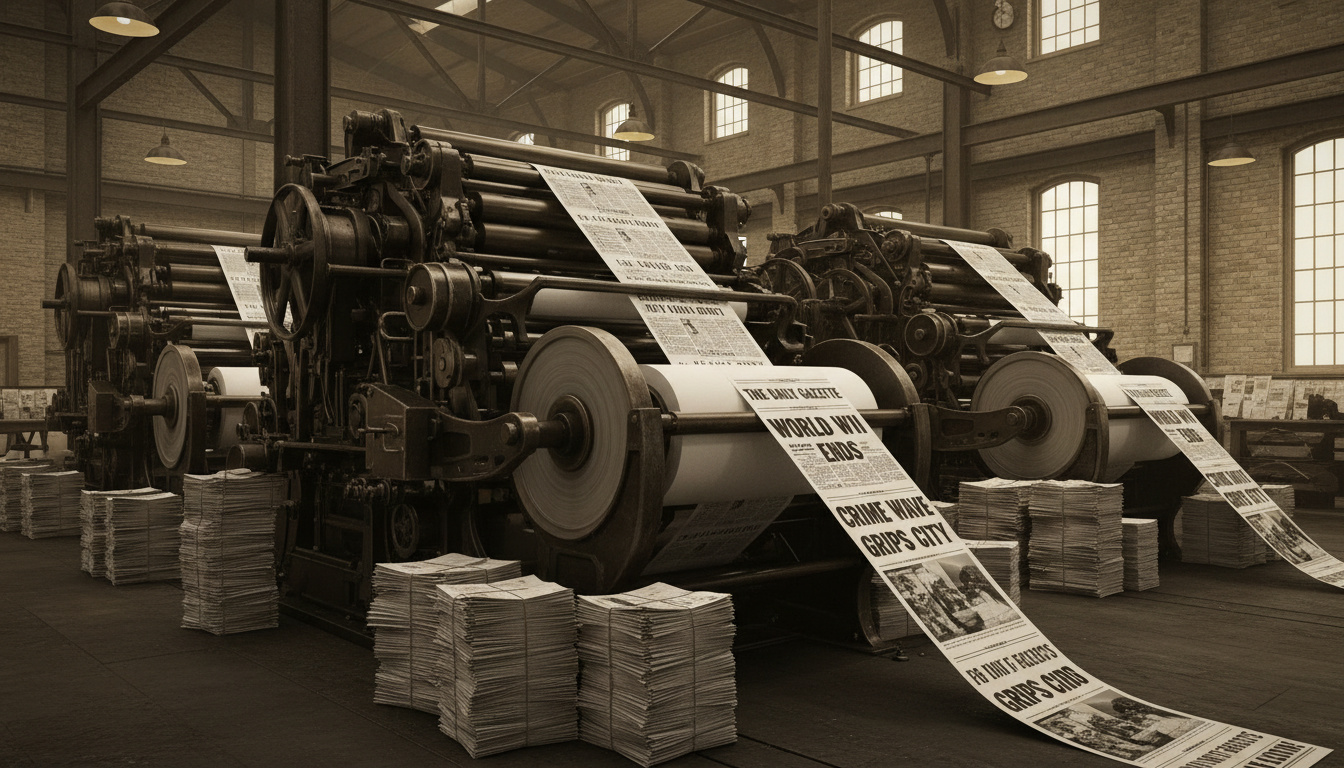
A newspaper delivers written accounts of current events through regularly scheduled publications, often daily or weekly. It serves as mass communication, sharing news, opinions, features, and other public interest details, largely supported by advertising.
Coverage extends to politics, business, sports, art, science, and religion. Newspapers also include opinion columns, weather reports, service reviews, obituaries, puzzles like crosswords and sudoku, cartoons, comics, and advice.
General newspapers cover national and international stories as well as local developments. Dedicated sections address politics, finance, crime, disasters, health, technology, entertainment, food, fashion, and arts.
What Is a Newspaper?
| Aspect | Details |
|---|---|
| Definition | Published periodical with news |
| Formats | Broadsheet, tabloid, online |
| History | From 1605 to present |
| Role | Public information source |
- Newspapers focus on current events as their core content.
- They include diverse sections for national, local and specialised news.
- Formats divide mainly into broadsheets and smaller tabloids.
- Additional features cover puzzles, comics and opinions.
- Modern versions blend print with online for deeper analysis.
- Advertising supports widespread distribution.
| Fact | Detail |
|---|---|
| First Newspaper | Relation (1605, Germany) |
| Frequency | Typically daily or weekly |
| Purpose | Mass communication on public interest |
| Topics | Politics, business, sports, science |
| Sections | National, local, sports, entertainment |
| Layout | Columns on folded newsprint |
| Formats | Broadsheet and tabloid |
| Modern Shift | Complement to online outlets |
| Content Depth | Analyses and trends coverage |
History of Newspapers
Origins and first publications
The first newspaper, titled Relation, emerged in 1605 as a weekly publication in Germany. Early versions spread across Europe as printed news sheets.
Evolution through centuries
Printing advancements accelerated development. The first U.S. newspaper appeared by 1690. The 19th century brought the penny press for broader reach.
For deeper historical details, explore the research.
Milestones in printing technology
The 1980s introduced color printing. Digital shifts in the 2000s reshaped the industry.
Types of Newspapers
Broadsheet vs tabloid formats
Newspapers divide into broadsheets and tabloids, with tabloids roughly half the size. Australiainsight classifies them by physical format.
Broadsheets use large sheets; tabloids offer compact design for easier handling.
Other classifications by frequency and scope
Further distinctions come from frequency—daily or weekly—and focus, such as general or local. Print and online versions both endure.
How Newspapers Are Produced
Printing process overview
Content arranges in columns on newsprint, printed on large sheets and folded. Cheap paper historically ensured affordability. University of North Florida Libraries outlines standard sectional layouts.
Modern vs traditional methods
Traditional printing produces physical copies, while modern methods pair digital formats with print.
Inexpensive newsprint historically maximised profitability and access.
Newspapers vs Other Media
Vs magazines
Newspapers emphasize timely current events, while magazines publish less often with specialized, in-depth material.
Vs digital news sources
Print newspapers complement online speed with analysis, stressing unique depth and trends. International Journal of Communication notes this evolution.
Print circulation declines with online growth, yet hybrid models emerge.
Newspaper History Timeline
- 1605: First weekly newspaper published in Germany.
- 1690: First newspaper in the US.
- 19th century: Penny press enables mass circulation. Wikipedia
- 1980s: Introduction of colour printing.
- 2000s: Digital disruption impacts industry.
- 2020s: Shift to hybrid print-digital models.
Established Facts vs Uncertainties in Newspapers
| Established Information | Information that Remains Unclear |
|---|---|
| Definition as periodical on current events | Exact future print circulation levels |
| Formats: broadsheet and tabloid | Long-term viability of physical editions |
| Sections for news, sports, opinions | Impact of AI on production |
| Origins from 1605 Germany | Global daily peak beyond early 2000s estimates |
The Role and Context of Newspapers
Newspapers provide broad access to public interest information. They organize news hierarchically, leading with front-page major events. Britannica details their mass communication role.
Sections cater to varied needs, from weather to classifieds. The layout supports quick scanning on newsprint.
Sources and Key Quotes on Newspapers
Newspapers remain vital for local news.
They offer in-depth analysis not found elsewhere.
International Journal of Communication
Newspapers: Key Takeaways
From 1605 origins to modern hybrids, newspapers persist as structured sources of news, views, and features. Formats evolve, but their depth stands out. See further research for updates.
Why are newspapers called newspapers?
The name combines “news” for current events and “paper” for the print medium.
What is the full meaning of newspaper?
A scheduled publication of written current event information.
Is newspaper a noun or verb?
Primarily a noun referring to the publication.
What are newspapers used for?
Delivering news, opinions and public interest content.
Will print newspapers disappear?
Uncertain; hybrids with digital persist amid declining print.
What is the oldest newspaper?
Relation from 1605 in Germany marks early origins.
How has newspaper readership changed?
Shift to online reduces print, per industry observations.

Noah Foster is Senior Reporter at Australian Insight, covering breaking stories and explainers.