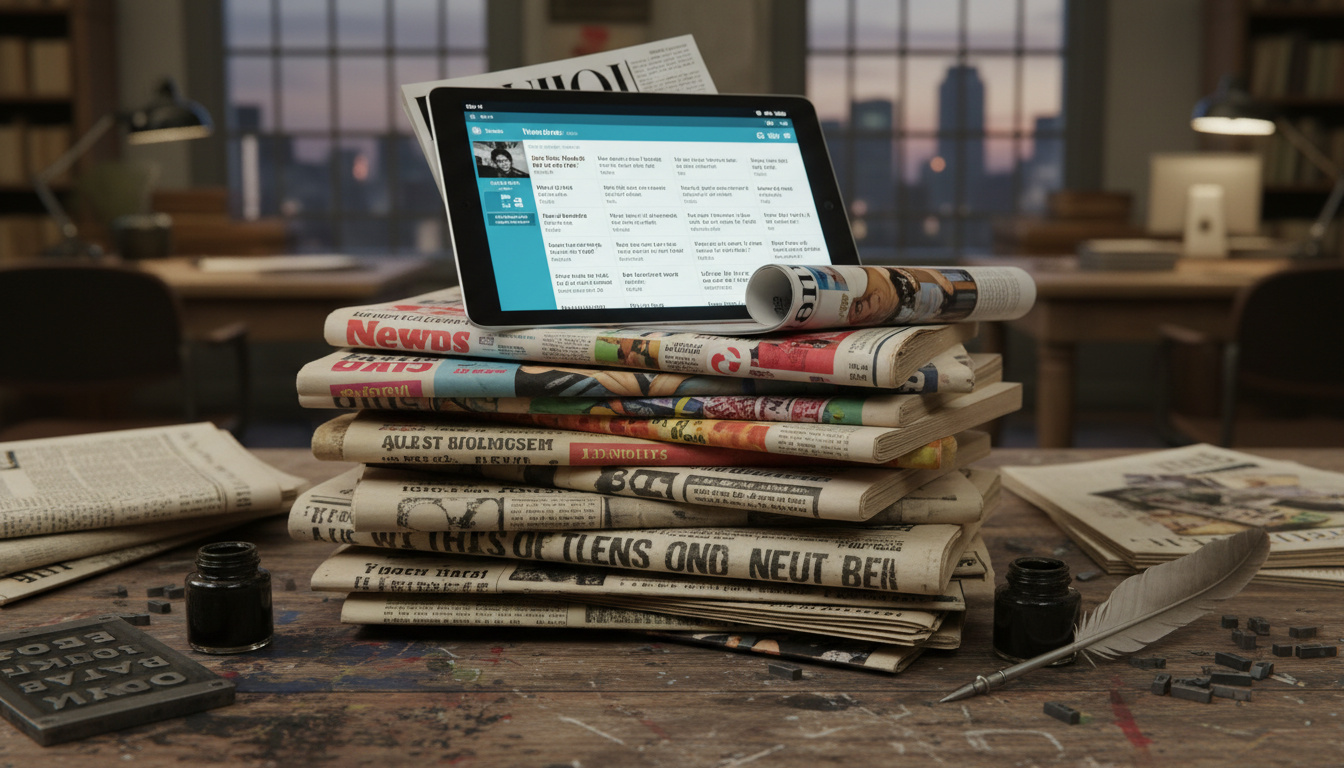

A newspaper serves as a key source of current events, blending news, opinions, features, and advertisements in a regularly published format. Typically issued daily or weekly, it has evolved from printed pages to digital platforms while maintaining core traits like public access and timely coverage.
These publications cover diverse topics from politics and business to local happenings and entertainment. Their structured sections help readers navigate everything from hard news to puzzles and reviews.
Defined by publicity, periodicity, currency, and universality, newspapers remain a cornerstone of information despite shifts in consumption habits.
What Is a Newspaper?
| Definition | Origin | Peak Circulation | Current Status |
|---|---|---|---|
| Published periodical with news | 17th century Europe | Mid-20th century | Shift to digital |
- Meets four criteria: publicity, periodicity, currency, and universality.
- Traditionally printed with black ink on white or gray paper.
- Includes news on politics, business, crime, weather, health, science, sports, entertainment, and local events.
- Features opinion columns, editorials, obituaries, reviews, puzzles, comics, and TV listings.
- Available in general-interest formats covering national, international, or local news.
- Now exists in both print and online versions.
- Local editions often use a conversational tone focused on community matters.
| Fact | Details | Year/Source |
|---|---|---|
| First Newspaper | Relation | 1605, Germany |
| Oldest Continuous | Post och Inrikes Tidningar | 1645, Sweden |
| Core Criteria | Publicity, periodicity, currency, universality | Wikipedia |
| Traditional Format | Black ink on white or gray paper | Wikipedia |
| News Coverage | Politics, business, crime, weather, more | Britannica |
| Features | Editorials, puzzles, comics | UNF LibGuides |
| Roman Precursor | Acta Diurna | Britannica |
| Global Titles | ~11,000 daily newspapers | 2023 est. |
| Modern Formats | Print and online | OKState Library |
History of Newspapers
Newspapers trace back to the 17th century, evolving from merchant information sheets and ancient Roman Acta Diurna into mass media.
What Is the Oldest Newspaper?
Post och Inrikes Tidningar, published since 1645 in Sweden, holds the record as the oldest continuously issued newspaper.
Who Invented the Newspaper?
No single inventor exists; early forms emerged from public notices in ancient Rome and European pamphlets.
Publications like Acta Diurna provided daily public news in ancient Rome, predating modern newspapers.
Types of Newspapers
Newspapers vary by size and focus, including broadsheets with larger pages and tabloids at half-size.
Tabloid vs Broadsheet
Broadsheets offer formal coverage in major outlets like The New York Times or The Guardian, while tabloids compact format suits quick reads.
Difference Between Newspaper and Magazine?
Newspapers prioritize current, timely news with daily or weekly periodicity, unlike magazines’ in-depth, less frequent features.
Local papers focus on community events in conversational style; nationals cover broader topics formally.
How Newspapers Are Made and Their Modern Role
Traditionally printed on large presses, newspapers now blend print runs with digital distribution for wider reach.
They play vital roles in informing society, upholding press freedom, and facing economic challenges from declining print circulation.
Print circulation in the US has dropped around 80% since 1990, per reports, amid online growth.
Key Milestones in Newspaper History
- 1605: First weekly newspaper, Relation, published in Germany. Wikipedia
- 1645: Post och Inrikes Tidningar begins in Sweden as oldest continuous title.
- 1690: First colonial US newspaper appears.
- 1833: Penny press makes news affordable to masses.
- 17th century: Evolution from merchant sheets and Roman Acta Diurna. Britannica
- 1980s: Digital shift begins with online editions.
- 2020s: AI tools enter newsrooms for curation.
- Mid-20th century: Peak global circulation.
What We Know vs What Remains Unclear About Newspapers
| Established Information | Information That Remains Unclear |
|---|---|
| Origins in 17th century Europe from ancient precursors. | Exact inventor or single starting point. |
| Core criteria: publicity, periodicity, currency, universality. Scribd source | Future print viability amid digital trends. |
| Types: broadsheet, tabloid, local/national. OKState Library | Precise global circulation declines. WAN-IFRA |
| Content sections: news, features, ads. | AI’s long-term impact on journalism. |
Role of Newspapers in Society
Newspapers inform the public on diverse issues, fostering debate through opinions and editorials.
They support press freedom and community engagement, though economic pressures challenge sustainability. Pew Research
Key Sources and Quotes
Newspapers evolved into mass media from 17th-century origins.
“Newspapers are the world’s mirrors.” – James Gordon Bennett
Historical collections confirm early US colonial publications.
Newspapers in Summary
From 1605 origins to digital hybrids, newspapers deliver timely, universal news despite print declines, remaining relevant through adaptability.
What does newspaper stand for?
Newspaper is not an acronym; it refers to a news-printed paper publication.
When was the first newspaper published?
Relation appeared in 1605 in Germany as the first weekly.
What are broadsheet newspapers?
Larger-format papers with formal, in-depth reporting.
Why are newspapers important?
They provide current, public news on broad topics, aiding informed society.
Are newspapers still relevant?
Yes, via digital shifts despite print drops.
What is the full form of newspaper?
No full form; it’s a descriptive term for news papers.
How are newspapers printed?
Traditionally on large presses with ink on paper rolls.
Related reading: Blog.
Related reading: News.
Related source: Australiainsight.

Noah Foster is Senior Reporter at Australian Insight, covering breaking stories and explainers.