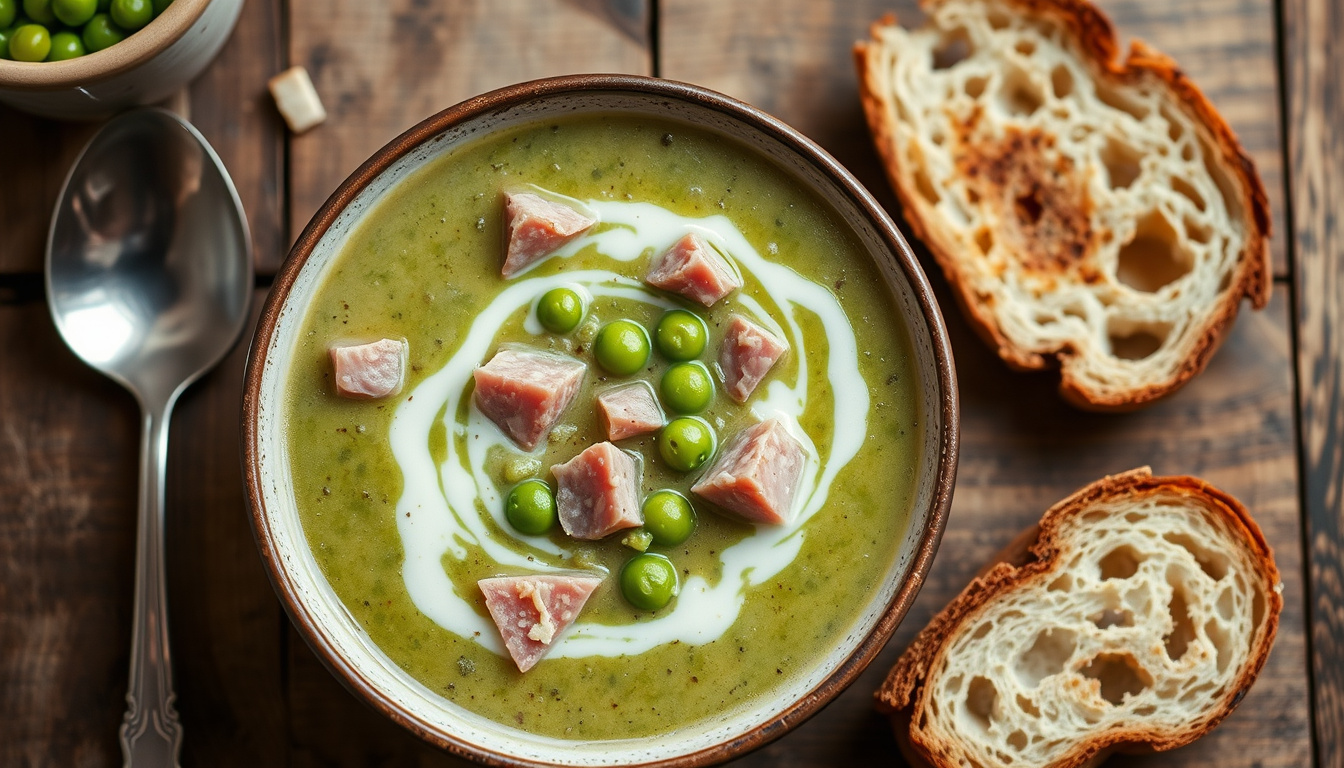
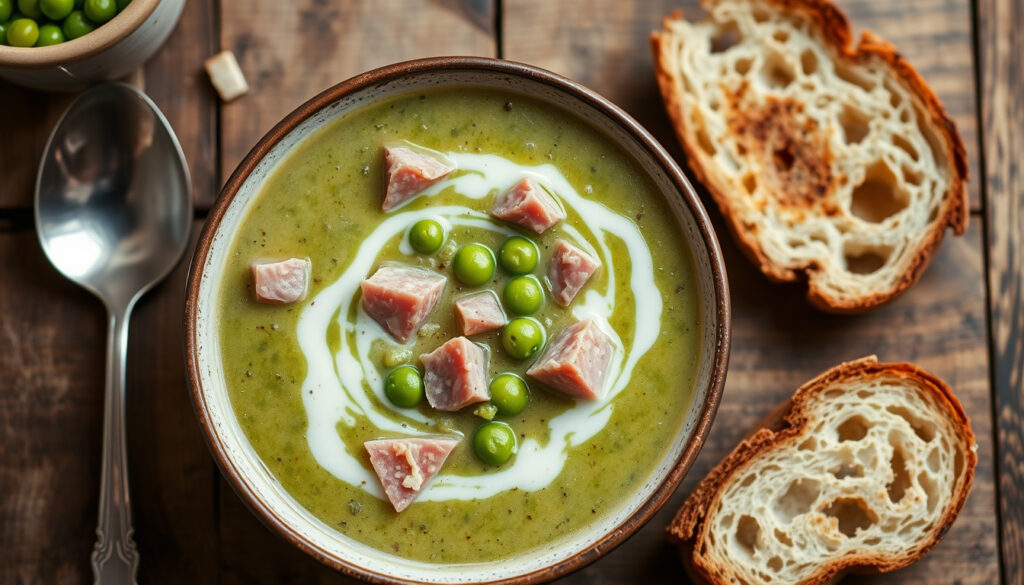
There is something deeply satisfying about a bowl of thick, smoky pea and ham soup on a cold day. Getting that silky texture and rich flavour right takes know-how — this guide walks through the traditional method, key decisions that affect taste, and common mistakes that turn a comforting classic into a bland letdown.
Traditional cooking time: 2-3 hours stovetop or 6-8 hours slow cooker ·
Split peas per serving: 1 cup dried split peas yields about 4 servings ·
Ham hock weight: 1 to 2 lbs (450-900 g) ·
Water-to-pea ratio: 6-8 cups liquid per 1 cup dried peas ·
Calories per serving: 300-400 kcal
Quick snapshot
- Ham hock adds essential depth of flavor (RecipeTin Eats (trusted home-cooking blog))
- Salt should be added at the end of cooking (Culinary Ginger (recipe developer))
- Soaking reduces cooking time but is optional (Grains & Legumes Nutrition Council (nutrition authority))
- Whether potatoes improve the soup is subjective (Culinary Ginger (recipe developer))
- Optimal water-to-pea ratio varies by recipe (Striped Spatula (cooking site))
- Effectiveness of ham cuts is not rigorously compared (RecipeTin Eats (trusted home-cooking blog))
- Whether green split peas are traditional is contested — yellow split peas are common in some regional variants (Culinary Ginger (recipe developer))
- Stovetop: 2.5 hours on low (RecipeTin Eats)
- Slow cooker: LOW 8-10 hours (RecipeTin Eats)
- Pressure cooker: HIGH 1-1h20m (RecipeTin Eats)
- Season with salt after cooking, not before (Culinary Ginger)
- Add diced ham in last 15 minutes (Striped Spatula)
- Store without ham bone to prevent over-seasoning (RecipeTin Eats)
How to make traditional pea and ham soup?
Six key ingredients, one pattern: the ham bone does the heavy lifting, and patience rewards you with a broth that tastes of smoke and earth. Here is how to build it properly.
Choosing the right ham hock
The ham hock is the heart of this soup. A smoked hock brings deep, woodsy flavour that split peas absorb as they break down. Look for a hock that is meaty — at least 1 to 2 lbs — with visible fat and skin, which render into the broth. RecipeTin Eats (trusted home-cooking blog) advises that if the ham bone is too lean, adding chopped ham pieces helps impart flavour and gives meat for shredding later.
Soaking split peas: necessary or not?
According to the Grains & Legumes Nutrition Council (nutrition authority), soaking split peas reduces cooking time but is optional. If you skip soaking, expect the soup to need an extra 30 minutes of simmering. Rinsing the peas thoroughly before cooking is non-negotiable — it washes off dust and any starch residue.
Step-by-step stovetop method
- Sauté one diced onion, two diced carrots, and two diced celery stalks in olive oil until softened — about 5 minutes.
- Add 1 lb (450 g) dried green split peas, 1-2 lbs smoked ham hock, 6 cups water or low-sodium stock, and 2 bay leaves.
- Bring to a boil, then reduce heat to low. Simmer covered for 2 to 3 hours, stirring occasionally, until the peas break down and the ham is tender enough to pull from the bone (Culinary Ginger (recipe developer)).
- Remove the ham bone, shred the meat, and return it to the pot. Discard the bone and bay leaves.
- Season with black pepper and salt — but only after tasting, because the ham may already provide enough salt.
The home cook faces a clear trade-off: a faster simmer (1 hour) yields a thinner broth; a longer simmer (2.5-3 hours) creates a creamier, more emulsified soup. The difference is texture, not safety.
Do you put water or stock in pea and ham soup?
Three common liquids, one critical variable: salt content. The wrong choice can either mute the ham or make the broth unpleasantly salty.
Water vs. chicken stock vs. vegetable stock
| Liquid | Flavour effect | Salt risk |
|---|---|---|
| Water | Lets ham flavour dominate; purest expression | Low — you control all salt |
| Chicken stock (low-sodium) | Adds savoury depth; broadens flavour base | Moderate — even low-sodium stocks contain some salt |
| Vegetable stock (low-sodium) | Adds mild sweetness; works if ham is already salty | Moderate — varies by brand |
Data from five sources, one pattern: most traditional recipes use only water. RecipeTin Eats uses water in its base recipe, while Striped Spatula uses a mix of chicken stock and water. If using stock, low-sodium is essential — ham already brings significant salt to the pot.
What this means: water is the safe default. Stock can add richness, but only if you account for the additional sodium. For first-timers, start with water; you can always stir in a little chicken stock powder later if the flavour needs a lift.
Do you put potatoes in pea and ham soup?
Potatoes divide soup makers. They add body and a creamy starch, but they also change the soup’s character from a pure pea purée toward a heartier, chunkier stew.
Pros and cons of adding potatoes
Upsides
- Adds body and creaminess without dairy
- Stretches the soup for extra servings
- Mild flavour complements peas and ham
Downsides
- Dilutes the pure split-pea flavour
- Can make soup gummy if overcooked
- Not traditional in classic British recipes
Alternative thickeners
Split peas themselves are powerful thickeners. After a 2-hour simmer, the peas naturally break down and emulsify into a creamy consistency. If you prefer an even thicker soup, Striped Spatula recommends pureeing a portion of the soup with an immersion blender. Potatoes are a common addition — Culinary Ginger suggests adding diced potatoes about 30 minutes into the simmer — but they are optional.
The trade-off: potatoes make the soup more filling and forgiving for meal prep; skipping them keeps the flavour focused squarely on the ham and peas. Choose based on whether you want a meal in a bowl or a showcase of the two starring ingredients.
How to make pea and ham soup taste better?
The complaint is familiar: “My pea and ham soup is bland.” The fix is rarely one ingredient — it is a system of timing and technique.
Why is my pea and ham soup tasteless?
The most common cause is adding salt too early. Culinary Ginger notes that early salt can make peas tough and suppress other flavours. The ham bone itself releases salt gradually — so the soup may taste flat mid-cook only to become perfectly seasoned by the end. Patience is the first flavour booster.
Another culprit: a skimpy ham bone. If the bone is small or mostly bare, RecipeTin Eats recommends adding chicken stock powder or extra ham pieces to compensate.
Flavour boosters: bay leaf, thyme, smoked paprika, black pepper
Herbs and spices lift the soup without competing with the ham. Striped Spatula uses bay leaf and fresh thyme; Garlic & Zest adds thyme leaves and bay leaf. A pinch of smoked paprika adds a second layer of smoke that echoes the ham hock. Freshly cracked black pepper — added at the table, not during cooking — provides a final aromatic kick.
The importance of salt timing and acid
Salt timing is the single most important technique in this soup. Add salt only after the ham has fully released its brine — usually at the very end of cooking. RecipeTin Eats stresses tasting before salting; many cooks find they need none.
A dash of acid at the end transforms a flat soup into a vibrant one. A squeeze of lemon juice or a teaspoon of white vinegar brightens the earthy split peas and cuts through the ham’s richness. Add it just before serving — acid added early can interfere with how split peas soften.
The home cook who adds salt at the start and acid at the start is fighting the peas’ chemistry. The cook who seasons at the end gets a soup that tastes layered, not flat. The fix is a change of sequence, not a change of ingredients.
What are common mistakes in split pea soup?
Even experienced cooks hit these snags. Here are the most frequent errors, and how to avoid them.
Adding salt or acidic ingredients too early
This is mistake number one. Salt draws moisture out of the peas and can slow their softening. Acid can prevent the peas from breaking down entirely. The rule: no salt, no lemon, no vinegar — until the ham is shredded and the soup is off the heat. Culinary Ginger explicitly advises adding salt only after tasting the finished soup.
Not skimming fat from the surface
Ham hocks release significant fat during cooking. Some fat adds richness; too much leaves a greasy mouthfeel. Striped Spatula recommends skimming the surface after cooking, or using a fat separator if you want a cleaner broth. For a richer soup, leave a spoonful or two of the rendered fat in the pot.
Overcooking or undercooking split peas
Split peas need enough time to break down — typically 1 to 2 hours — but they can turn into a uniform paste if left too long. Garlic & Zest aims for about 1 hour of simmering; RecipeTin Eats goes for 2.5 hours. The sweet spot is when the peas are tender but still hold a faint shape before stirring breaks them down.
The pattern: mistakes in split pea soup are nearly always about timing — when you add ingredients, not which ingredients you use. Adjusting the sequence fixes most problems.
Expert perspectives
“The ham bone is the heart of this soup – never skip it.”
RecipeTin Eats (trusted home-cooking blog)
“Using a ham stock cube can boost flavor if time is short.”
For those who prefer a hands-off approach, this slow cooker split pea and ham soup delivers the same deep, smoky flavor with minimal effort.
Frequently asked questions
Can I use yellow split peas instead of green?
Yes. Yellow split peas are milder and slightly sweeter than green. They cook at the same rate and produce a similar texture. The colour difference is cosmetic — the soup will be golden instead of green.
How do I store leftover pea and ham soup?
Refrigerate in an airtight container for up to 5 days. The soup thickens considerably as it sits; thin it with a splash of water or stock when reheating. Remove the ham bone before storing to prevent the soup from becoming overly salty.
Can I make pea and ham soup in a slow cooker?
Yes. Cook on LOW for 8 to 10 hours, or on HIGH for 6 hours. Add all ingredients except salt at the start; season after cooking.
Should I remove the ham bone before serving?
Yes. Remove the bone, shred any meat still attached, and return the meat to the pot. The bone itself adds no further flavour after cooking and can be discarded.
What herbs go well with pea and ham soup?
Bay leaf and fresh thyme are the classics. A sprig of rosemary can work, but use it sparingly — it can dominate. Smoked paprika adds an extra layer of smoke that complements the ham hock.
Is pea and ham soup gluten-free?
Yes, when made with whole ingredients. Split peas, fresh vegetables, and ham hock are naturally gluten-free. If using stock, check the label for gluten additives; most plain stocks are safe.
Can I use leftover ham instead of a ham hock?
You can, but the flavour will be less intense. Leftover ham lacks the collagen and bone marrow that give hock-based soups their body and depth. To compensate, add chicken stock powder or extra ham pieces.
How to thicken pea and ham soup without potatoes?
Use an immersion blender to puree a portion of the soup, or mash some of the peas against the side of the pot with a wooden spoon. The split peas themselves release enough starch to create a creamy consistency given enough simmering time.
For the home cook who wants a soup that tastes deliberate — not accidental — the lesson is sequence. Add salt at the end, add acid just before serving, and let the ham hock do its slow work. The result is a bowl that tastes of smoke, earth, and patience. For the cook making this soup for the first time, the decision is clear: trust the ham bone, watch the water level, and do not rush the simmer.

Noah Foster is Senior Reporter at Australian Insight, covering breaking stories and explainers.