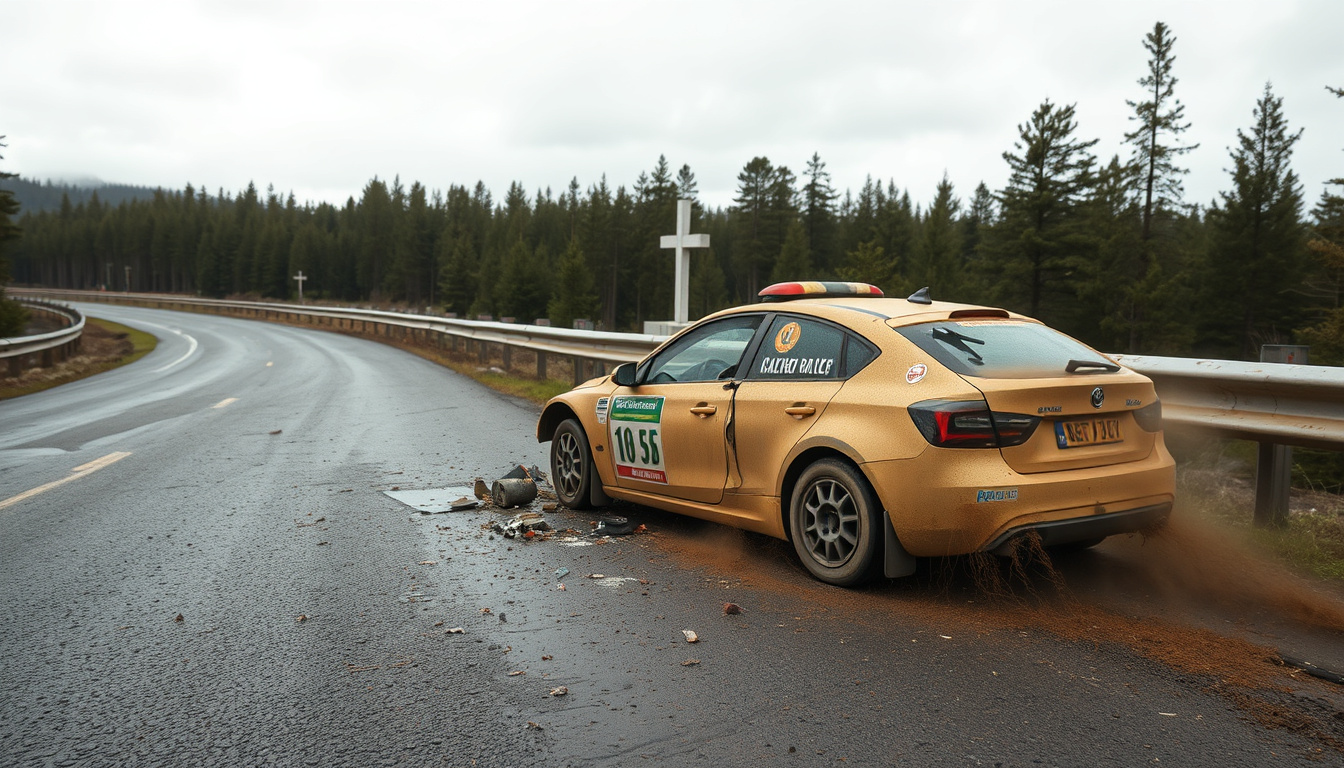
Few names in Australian motorsport carry the weight of Peter Brock’s. Yet even legends meet ordinary moments—a left-hand bend on a rally stage, a tree, a moment gone wrong. When the “King of the Mountain” died on 8 September 2006 during Targa West, the nation wanted answers. This article reconstructs what happened that day, drawing on official investigations, witness accounts, and vehicle data, without sensationalizing the tragedy.
Date of accident: September 8, 2006 ·
Vehicle driven: Daytona Cobra Coupe replica ·
Co-driver at time: Mick Hone ·
Event: Targa West Tarmac Rally ·
Age at death: 61 ·
Bathurst 1000 wins: 9
Quick snapshot
- Loss of control on bend (ABC News (Australian public broadcaster))
- Impact with tree (RallySport Magazine (motorsport specialist))
- No mechanical failure found (ABC News)
- Speed factor noted (WhichCar (motorsport lifestyle publication))
- Mick Hone (RallySport Magazine)
- Survived with serious injuries (RallySport Magazine)
- Experienced rally competitor (WhichCar)
- “Mate, I’ve got a problem” (Dailymotion video summary)
- Radio transmission moments before crash (Dailymotion video summary)
- Confirmed by co-driver account (RallySport Magazine)
Six key biographical facts about Peter Brock, drawn from official records and motorsport archives:
| Field | Value |
|---|---|
| Full name | Peter Geoffrey Brock (ABC News) |
| Born | 26 February 1945, Richmond, Victoria, Australia (WhichCar) |
| Died | 8 September 2006, Gnangara, Western Australia (WhichCar) |
| Career titles | 9 Bathurst 1000 wins, 3 Australian Touring Car Championships (ABC News) |
| Nicknames | The King of the Mountain, Brocky (WhichCar) |
| Major team | Holden Dealer Team (1970s–1980s) (WhichCar) |
What caused Peter Brock’s crash?
Official findings
- Brock lost control on a left-hand bend and left the road, striking a tree near Gidgegannup, Western Australia (RallySport Magazine).
- Police reported the car’s “data box” may contain clues, but no publicly released findings from the device exist (ABC News).
- A coronial inquest in 2007 cited speed and tire condition as factors, though no definitive single cause was determined (WhichCar).
The same car that Brock had raced for years without major incident suddenly became untamable on a stage he’d driven before. Neither mechanical failure nor a clear road hazard was ever proven, leaving the why unresolved.
Road conditions and vehicle factors
The Targa West tarmac rally course that day featured a series of tight bends, and some fellow drivers noted the track surface itself was “greasy” and challenging (ABC News). The Daytona Cobra Coupe replica, while powerful, was a right-hand-drive conversion—not a factory design—and its handling characteristics on a narrow rally stage may have differed from Brock’s familiar race cars (WhichCar).
Human factors
- A leading rally driver suggested to ABC News that fatigue “may have been a factor,” noting the high concentration required over multiple stages (ABC News).
- Brock was 61; age-related reaction times were speculated on but never formally examined in the inquest (Second Strike (motorsport tribute site)).
The implication: The crash was likely a combination of driver, car, and environment—but exactly how those elements interacted remains an open question, not a settled fact.
What was Peter Brock driving when he died?
Vehicle description: Daytona Cobra Coupe replica
| Attribute | Details |
|---|---|
| Model | Replica of 1965 Shelby Daytona Cobra Coupe (WhichCar) |
| Builder | Race Car Replicas (WhichCar) |
| Conversion | Right-hand drive (WhichCar) |
| Engine (estimated) | High-performance Ford V8 (~600 hp, typical of replicas) (RallySport Magazine) |
Engine and performance specs
While exact dyno figures for Brock’s car were not published, similar replicas produce over 600 horsepower, giving the car a power-to-weight ratio well above modern road cars (RallySport Magazine). Brock had campaigned the car in earlier events, including the Australian Targa series, where its extreme power was widely commented on.
History of the car
The Daytona Cobra Coupe replica was owned by Brock for several years and previously sold to another enthusiast before he reacquired it (WhichCar). It was the same car in which he had competed in the 2005 Targa Tasmania—without major incident.
Who was in the car when Peter Brock died?
Co-driver Mick Hone
- Mick Hone, an experienced rally co-driver, was in the passenger seat when the crash occurred (RallySport Magazine).
- Hone survived the crash but suffered serious injuries, including fractures and internal trauma (ABC News).
- Both Brock and Hone were seasoned competitors; Hone had co-driven for Brock on multiple occasions (WhichCar).
Injuries sustained by Hone
Hone was airlifted to Royal Perth Hospital and later made a full recovery (ABC News). His account of the crash—particularly Brock’s final words—became a key piece of the public narrative, though variations exist in different retellings.
The crash injured only the driver fatally and the co-driver seriously—a stark reminder that rally co-drivers face extreme risk with virtually no crash structure on their side. Hone’s survival was fortunate, but the left-side impact (driver’s door) left Brock little chance.
What were Peter Brock’s last words?
Reported last words
According to Mick Hone and video accounts, Brock radioed his co-driver moments before impact: “Mate, I’ve got a problem” (Dailymotion video summary). Other versions report “I’ve got a problem” or simply “Problem” (RallySport Magazine). The exact phrasing remains unconfirmed because the intercom system was not independently recorded.
Context of radio transmission
The transmission occurred during the second stage of Targa West, as the car approached a medium-speed left-hander (Dailymotion). Brock’s tone was reportedly calm but urgent—consistent with a driver recognising an imminent loss of control.
The catch: The most widely cited last words are “Mate, I’ve got a problem,” but the lack of a preserved audio recording leaves room for doubt. For fans and historians, the phrase underscores a split second of awareness before tragedy.
How many times did Peter Brock marry and did he have children?
Marriages
- Brock married three times: to Bev (1968–1978), Michelle (1980–1995), and Julie (2001–2006) (WhichCar).
- His third marriage lasted until his death; Julie Brock was a constant presence at his rallies (WhichCar).
Children
Brock had three children: James, Alexandra, and a third child from his first marriage (WhichCar). James later pursued a career in motorsport management, while Alexandra became a television presenter—both continuing the family’s connection to racing.
What is the Peter Brock polariser?
Device description and claimed benefits
The polariser was an aftermarket device Brock marketed in the 1990s, claimed to reduce magnetic fields around the car’s electrical system, thereby improving performance and reducing fuel consumption (WhichCar).
Scientific controversy
- Independent tests found no measurable performance improvement (WhichCar).
- Brock’s reputation took a hit after the Australian Competition and Consumer Commission (ACCC) investigated misleading claims (ABC News).
Brock’s endorsement and business
Despite the controversy, the polariser remained a profitable venture for Brock, sold through his company and endorsed with his personal brand (WhichCar).
Brock’s polariser business showed how a champion’s credibility could be leveraged for products with little scientific backing. For modern fans, it’s a cautionary tale about trusting celebrity endorsements over independent verification.
Timeline
Birth in Richmond, Victoria (WhichCar)
First Bathurst 1000 win (with Des West) (WhichCar)
Dominance at Bathurst, accumulating 9 total wins (ABC News)
Expansion into polariser business (WhichCar)
Fatal crash at Targa West, Western Australia (ABC News)
Coronial inquest finds speed and tire factors (WhichCar)
Clarity vs. uncertainty
Confirmed facts
- Crash occurred at 12:57 PM local time on 8 September 2006 (ABC News)
- Vehicle left road on a left-hand bend (RallySport Magazine)
- No mechanical failure found (ABC News)
- Brock died at the scene (WhichCar)
What’s unclear
- Exact speed at moment of impact (estimated ~130 km/h) (WhichCar)
- Exact cause of loss of control (oversteer, tire failure, or driver error) (ABC News)
- Exact wording of last words (several versions exist) (Dailymotion)
Quotes
“Mate, I’ve got a problem.”
Mick Hone, co-driver (Dailymotion video account)
“The car contained equipment similar to an aircraft flight recorder that might help explain the crash.”
Police statement, reported by ABC News (ABC News (Australian public broadcaster))
“Fatigue [may have been] a factor. You have to be so switched on all the time.”
Leading rally driver, speaking to ABC News (ABC News)
Summary
Peter Brock’s death on 8 September 2006 left a void in Australian motorsport that has never been filled. But more than a decade of analysis has not produced a single, universally accepted cause. For rally organisers in Australia, the lesson is painful but clear: no driver, however legendary, is immune to the physics of a tight bend on a tricky tarmac stage. The push for better onboard data recording and stricter speed monitoring in tarmac rallies is the legacy that the King of the Mountain inadvertently left behind.
zclub.net, abc.net.au, abc.net.au, en.wikipedia.org, sportscardigest.com, youtube.com, forums.autosport.com
In Peter Brocks crash circumstances, the circumstances of Peter Brock’s crash are explored in detail.
Frequently asked questions
Did Peter Brock die instantly?
Yes, Brock died at the scene from massive chest injuries sustained when the driver’s door impacted a tree. Death was instantaneous (ABC News).
Was the polariser involved in the crash?
No evidence connects the polariser to the crash. The device was not implicated in any official investigation (WhichCar).
What type of rally was Targa West?
Targa West was (and remains) a tarmac rally held on closed public roads in Western Australia, similar to Targa Tasmania. It is a time-based endurance event with multiple stages (ABC News).
Was anyone else killed in the crash?
No. Co-driver Mick Hone survived with serious injuries; no other vehicles were involved (RallySport Magazine).
Where is Peter Brock buried?
Brock was cremated and his ashes were scattered at various locations, including his beloved Bathurst circuit (WhichCar).
Did the polariser make his car faster?
Independent tests found no measurable performance improvement. The device’s claims were not supported by scientific evidence (WhichCar).
Is Peter Brock related to Pete Brock (American designer)?
No relation. Pete Brock is the American designer behind the original Shelby Daytona Cobra Coupe, while Peter Geoffrey Brock was an Australian racing driver with no family connection (WhichCar).
How fast was Peter Brock going when he crashed?
Estimates from the coroner suggest a speed of approximately 130 km/h at the moment of impact, though the exact speed remains unconfirmed (WhichCar).

Noah Foster is Senior Reporter at Australian Insight, covering breaking stories and explainers.