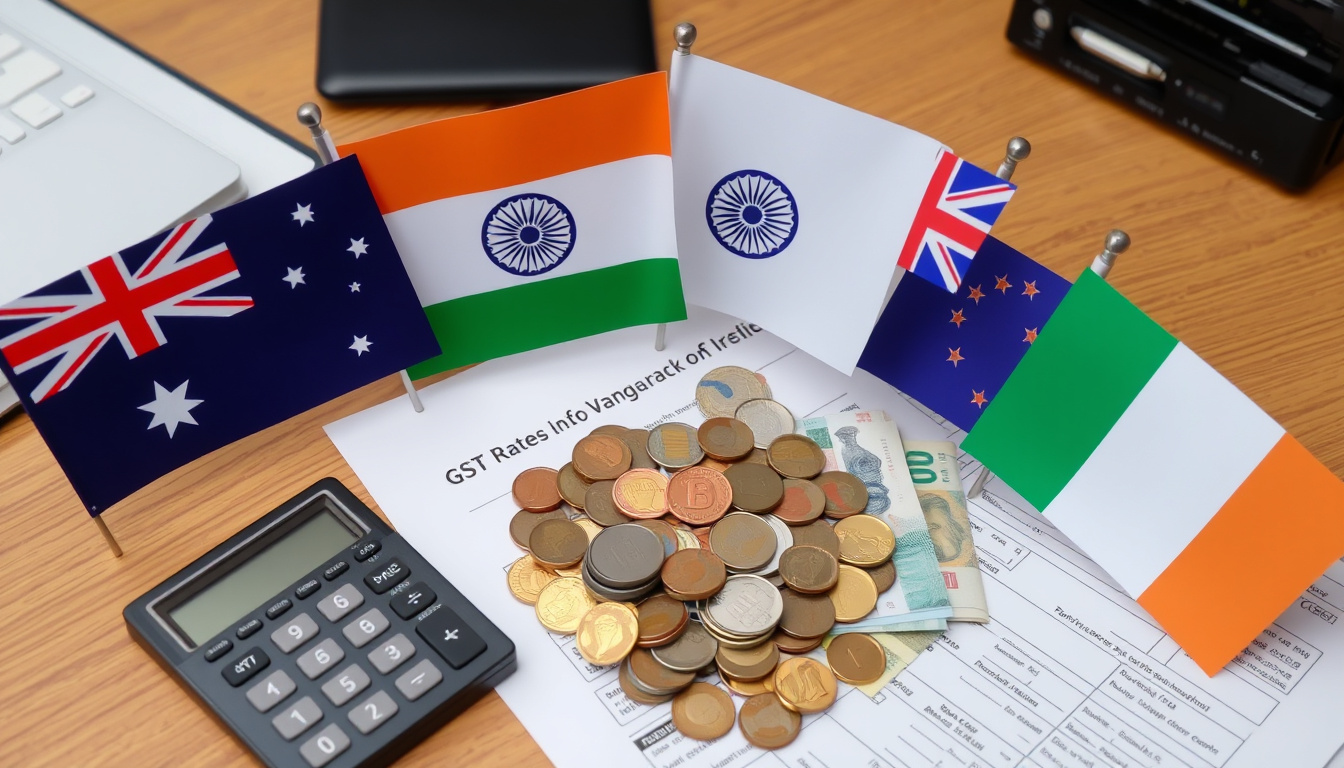
Few tax questions pop up as often as “how much is GST?” Whether you’re pricing a product, checking a receipt, or planning a business budget, the answer depends entirely on where you are. This guide covers current GST rates in Australia, India, New Zealand, and Ireland, along with simple formulas to calculate GST on any amount. You’ll walk away knowing exactly what to charge or claim — no calculator needed.
Australia GST rate: 10% ·
New Zealand GST rate: 15% ·
Ireland VAT standard rate: 23% ·
India GST slabs: 5%, 12%, 18%, 28% ·
Countries with GST/VAT: over 160
Quick snapshot
- Australia GST: 10% (Stripe (payment infrastructure))
- New Zealand GST: 15% (PwC Tax Summaries)
- Ireland VAT standard: 23% (PwC Tax Summaries) (Stripe (payment infrastructure))
- India GST slabs: 5%, 12%, 18%, 28% (PwC Tax Summaries) (Stripe (payment infrastructure))
- Potential future rate changes in any country (not covered by current data)
- Specific exemptions and zero-rated items vary by jurisdiction
- Exact application of reduced VAT rates in Ireland to specific categories (e.g., tourism) may require professional tax advice
- GST registration thresholds differ by country and may affect whether a business needs to charge GST
- Australia GST introduced 2000 (Stripe) (Trading Economics)
- India GST implemented July 2017 (Trading Economics)
- Ireland VAT rates last reviewed March 2026 (PwC) (Trading Economics)
- Australia rate steady at 10% since 2006 (Trading Economics)
- Use official calculators for exact amounts
- Check local tax authority for updates
- Understand inclusive vs exclusive pricing
The table below summarizes the standard and reduced rates for the countries covered.
| Country | Standard rate | Source |
|---|---|---|
| Australia | 10% | Stripe |
| New Zealand | 15% | PwC Tax Summaries |
| India (general) | 18% | PwC Tax Summaries |
| India (lowest slab) | 5% | Commenda (tax compliance platform) |
| India (highest slab) | 28% | PwC Tax Summaries |
| Ireland | 23% | PwC Tax Summaries |
| Ireland (reduced) | 13.5% | UniRateAPI (rate database) |
How much GST is in $100?
GST calculation formula
- If the $100 is GST inclusive (price already includes tax): GST amount = $100 × 10/110 = $9.09. (Moneysmart (Australian consumer finance guide))
- If the $100 is GST exclusive (price before tax): GST amount = $100 × 10% = $10.00. (Stripe)
Examples for different amounts
- $500 exclusive: GST = $50. Inclusive total = $550. (PwC guidance)
- 18% GST on $10,000 (India): GST = $1,800. Total = $11,800. (Commenda)
- 12% GST on $20,000 (India slab): GST = $2,400. Total = $22,400. (PwC Tax Summaries)
Using a GST calculator
- Australian GST calculator: Moneysmart (official tool from ASIC)
- New Zealand GST calculator: Inland Revenue
- India GST calculator: GST Council portal
The implication: understanding whether a price is inclusive or exclusive is crucial for accurate calculation.
Is GST 10 or 11 percent in Australia?
Current Australian GST rate
- Australia’s standard GST rate is 10% and has been since its introduction in 2000. (Stripe)
- Trading Economics confirms the rate averaged 10% from 2006 through 2025 and projects 10% for 2026. (Trading Economics)
Historical changes
- The GST rate has never been 11% in Australia. No official proposal or legislation supports a change to 11%.
- The Australian Treasury notes the country’s GST rate is roughly half the unweighted OECD average of 19.2%. (Australian Treasury (government policy))
Exceptions to 10%
- Some items are GST-free: most fresh food, education, medical services, and childcare. (Australian Taxation Office (tax regulator))
- Exports and certain international supplies may be zero-rated.
The pattern: Australia’s 10% rate is unusually low by OECD standards — a deliberate design to minimise the tax burden on essentials.
How do you calculate GST price?
Step-by-step calculation
- Adding GST (i.e., find total including tax): multiply the price by 1 + (rate/100). For 10%: price × 1.1. (Moneysmart)
- Removing GST (i.e., find pre-tax price from total): divide the total by 1 + (rate/100). For 10%: total ÷ 1.1. (Stripe)
Formula in action
The following table demonstrates the formulas in action for Australia’s 10% GST.
| Scenario | Action | Example (10%) | Source |
|---|---|---|---|
| Exclusive → Inclusive | Price × 1.1 | $200 × 1.1 = $220 | Moneysmart |
| Inclusive → Exclusive | Total ÷ 1.1 | $220 ÷ 1.1 = $200 | Moneysmart |
Using a calculator
- Online GST calculators (Moneysmart, Wise) automate the math. Simply input the amount and select “GST included” or “GST excluded”.
- For India’s 18% slab, multiply by 1.18 to include tax; divide by 1.18 to remove it.
The trade-off: manual calculation works for a single amount, but businesses handling hundreds of transactions should automate via accounting software or a GST calculator tool.
What is the GST rate in Ireland?
Ireland VAT rates
- Standard VAT rate: 23% (PwC Tax Summaries)
- Reduced rate: 13.5% (e.g., construction, tourism) (Revenue Commissioners (Irish tax authority))
- Second reduced rate: 9% (e.g., newspapers, sports facilities)
- Livestock rate: 4.8% (UniRateAPI)
New Zealand GST
- New Zealand GST is 15%, a single rate on most goods and services. (PwC Tax Summaries)
- Administered by Inland Revenue.
India GST slabs
- Four main slabs: 5% (essentials), 12% (processed foods, computers), 18% (general), 28% (luxury). (Commenda)
- A compensation cess applies to certain luxury and sin goods. (PwC Tax Summaries)
Other countries
- Over 160 countries have some form of GST or VAT. Rates range from 0% (e.g., some goods in Canada) to 27% (Hungary).
- The OECD average VAT rate is 19.2%, placing Australia well below the mean. (Australian Treasury)
Why this matters: A business importing from Ireland to Australia faces a 23% Irish VAT upfront, then 10% Australian GST on the landed cost. Double-taxation treaties can reduce the hit.
Does the 12% GST rate still exist?
India GST slab 12%
- Yes, India continues to apply a 12% GST slab to goods such as processed foods, mobile phones, and computers. (Commenda)
- India’s five-rate structure (0%, 5%, 12%, 18%, 28%) remains in effect as of 2026. (PwC Tax Summaries)
New Zealand GST 15%
- New Zealand’s single-rate GST of 15% has been unchanged since 2010. No “12%” exists there.
How to check current rates
- For India: GST Council official website or PwC Tax Summaries.
- For all countries: consult the local tax authority or a trusted aggregator like Trading Economics.
The catch: Even though the 12% slab exists in India, many consumer goods are rated 18% under the “general” category. Always verify the HSN code for the specific product.
Comparison table: GST/VAT rates by country
Four major economies, four distinct approaches: Australia’s low 10% single rate, New Zealand’s 15%, India’s multi-slab system, and Ireland’s tiered VAT.
| Country | Standard rate | Reduced rates | Source |
|---|---|---|---|
| Australia | 10% | N/A (some zero-rated) | Stripe |
| New Zealand | 15% | N/A (single rate) | PwC |
| India | 18% | 5%, 12%, 28% | Commenda |
| Ireland | 23% | 13.5%, 9%, 4.8% | Revenue Commissioners |
The pattern: each country’s rate structure reflects its economic priorities, with Australia opting for a low, simple rate and India using multiple slabs.
How to calculate GST: step-by-step
For anyone who wants a concrete workflow—whether you’re a sole trader or a finance manager.
- Identify the rate. Check the jurisdiction and product category. (Australia 10%, NZ 15%, India see slab, Ireland check reduced rates.)
- Determine if the price is inclusive or exclusive. Ask the seller or look at the invoice. In Australia, retail prices usually include GST.
- Choose the formula:
- Exclusive price: GST = price × (rate/100). Add to get total.
- Inclusive price: GST = total × (rate / (100+rate)). Subtract to get base.
- Use a calculator — Moneysmart for Australia, Inland Revenue for NZ, GST portal for India — to verify.
- Record the GST component for your BAS or VAT return. Keep receipts with the tax breakdown.
For businesses, automating this in accounting software (e.g., Xero, MYOB, QuickBooks) eliminates manual errors and saves hours each quarter.
Confirmed facts vs. what’s unclear
Confirmed facts
- Australia GST rate is 10% as of 2026 (Stripe)
- New Zealand GST rate is 15% (PwC)
- Ireland VAT standard rate is 23% (PwC)
- India has four GST slabs: 5%, 12%, 18%, 28% (Commenda)
- Australia’s rate is the fourth lowest among 32 OECD countries (Australian Treasury)
What’s unclear
- Potential future rate changes in any country are not covered by current data
- Specific exemptions and zero-rated items vary by jurisdiction
- Exact application of reduced VAT rates in Ireland to specific categories (e.g., tourism) may require professional tax advice
- GST registration thresholds differ by country and may affect whether a business needs to charge GST
What this means: while the core rates are stable, businesses must monitor local tax authority updates for changes and exemptions.
What the authorities say
The GST is a broad-based tax of 10% on most goods, services and other items sold or consumed in Australia.
GST (goods and services tax) is 15%.
Standard VAT rate is 23%, reduced rates 13.5% and 9%.
— Revenue Commissioners Ireland (tax collection agency)
For Australian businesses, the implication is clear: your GST burden is just 10%, but your paperwork must be precise. Miss the $75,000 turnover threshold and you risk penalties. For cross-border sellers, the pattern is stark: Ireland’s 23% VAT means a bigger upfront cost than New Zealand’s 15% or Australia’s 10%. Compare rates before pricing your exports.
Australia’s 10% GST is exactly half the OECD average of 19.2%, meaning a $100 item carries only $9.09 in GST inclusive — versus $18.70 in the average OECD country. That gap shapes pricing strategy for both imports and exports.
Low GST keeps consumer prices down but shifts tax burden to other areas (e.g., income tax). For a business, the savings on GST compliance are real but offset by higher payroll taxes.
Frequently asked questions
What items are GST-free in Australia?
Most basic food (bread, milk, fruit, vegetables), education, medical services, childcare, and exports. (Australian Taxation Office)
How can I claim GST back?
If you’re a registered business with GST turnover above $75,000, you can claim input tax credits on business purchases. Lodge a Business Activity Statement (BAS) quarterly or monthly. (Australian Taxation Office)
Is GST the same as VAT?
Yes, essentially. GST (goods and services tax) is a type of value-added tax (VAT). The terms are used interchangeably; Australia, NZ, India call it GST, Ireland calls it VAT. (Stripe)
How often do GST rates change?
It varies. Australia’s 10% has been unchanged since 2000. NZ’s 15% since 2010. India’s slabs are reviewed periodically by the GST Council. Ireland last adjusted rates in 2021. (Trading Economics)
How to calculate GST on international purchases?
First, know the rate in the seller’s country. If importing into Australia, you may also owe GST at 10% on the landed value (goods + shipping + insurance). Use the customs GST calculator. (Australian Border Force)
Do all countries have GST?
No. About 160 of the 195 UN-recognised countries have some form of VAT/GST. The US is a notable exception, using state sales taxes instead. (PwC)
What is the difference between GST inclusive and exclusive?
Inclusive means the quoted price already contains the GST. Exclusive means GST is added at checkout. Australian retail prices are typically inclusive. (Moneysmart)
The catch: answers may vary based on specific circumstances, so always consult a tax professional.

Thomas Grant leads fact-checking, source verification and corrections at Australian Insight.