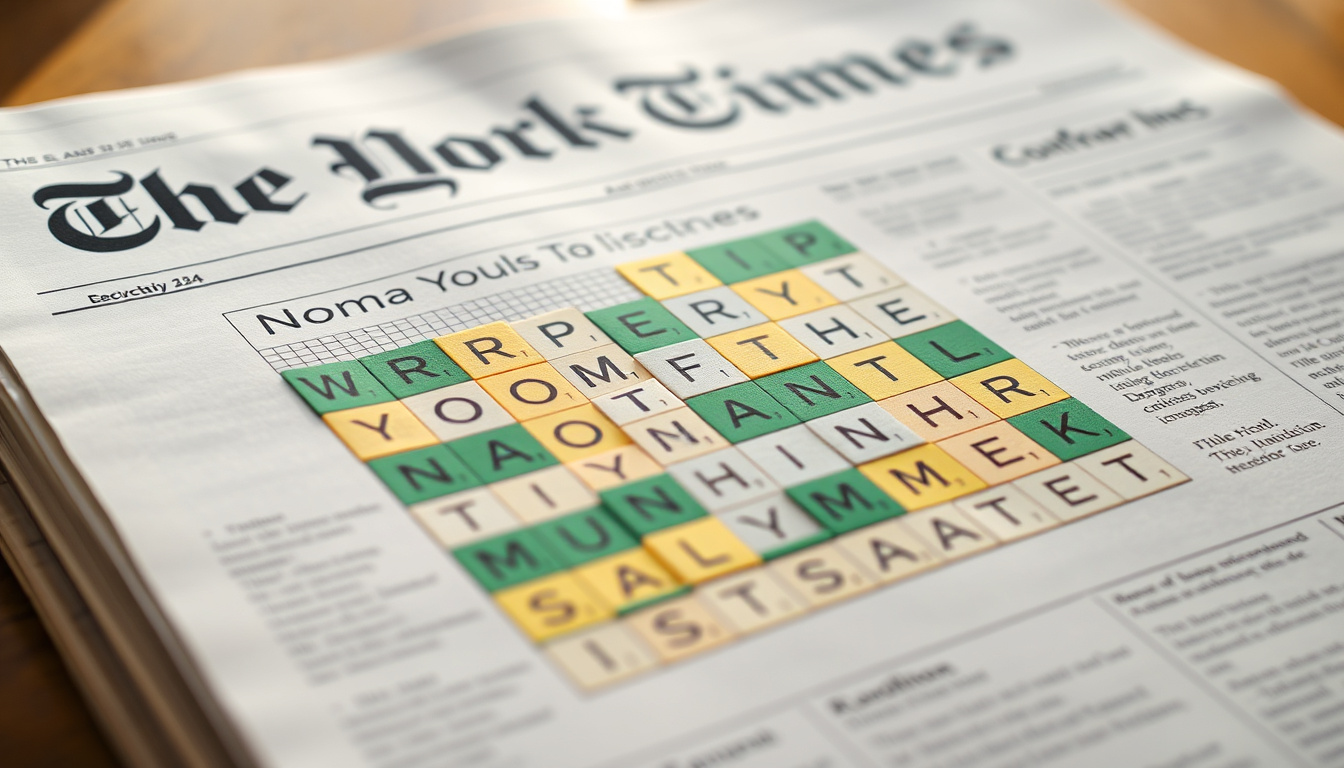

Wordle’s daily reset ritual turned casual word-play into an obsessive habit for millions when The New York Times acquired it from creator Josh Wardle. Whether you’re chasing today’s answer, hunting for better starting words, or wondering what else the Games app offers, here’s everything you need in one place.
Publisher: The New York Times · Game Type: Daily word puzzle · Platforms: Web, iOS app, Android app · App Name: NYT Games: Wordle & Crossword · Related Games: Connections, Spelling Bee, Strands
Quick snapshot
- Exact daily active player counts are not publicly disclosed
- Full list of NYT-added words beyond original 2,309 has not been published
- Wordle #1764: TOADY (April 18, 2026) · Wordle #1765: STAND (April 19, 2026) (Word Finder)
- Wordle #1726: TEDDY (March 11, 2026) · Wordle #1625: MUGGY (November 30, 2025) (Word Finder)
- NYT has started repeating past Wordle answers to manage the growing solution list (TechRadar)
- Both NYT and creator Josh Wardle have stated the game will remain free (Tom’s Guide)
Official links and storefronts give you direct access to the full NYT Games ecosystem — bookmark these to stay current.
| Resource | URL |
|---|---|
| Official Site | nytimes.com/games/wordle/index.html |
| Android App | Google Play Store (NYT Games app) |
| iOS App | Apple App Store (NYT Games app) |
| Spelling Bee | nytimes.com/puzzles/spelling-bee |
New York Times Wordle Answer
Wordle puzzles run in sequence by number, not by calendar date, which means checking an archive is the most reliable way to find past answers. The game first launched with CIGAR as the solution in June 2021, and by April 2026 had reached puzzle #1766 (Word Finder). If you’re looking for today’s answer from an external source rather than playing live, several outlets publish daily hints alongside their answer reveals.
Today’s hints
When you want a nudge without a full reveal, hints typically guide you through logical filters rather than spelling the word outright. The standard hint system in Wordle works by narrowing possibilities based on what you already know:
- Vowel check: If your starting word lacks A, E, I, O, U, or Y, you’re working blind on one of the most powerful filters.
- Position confirmed: When a letter turns green, lock it in and build around its exact position.
- Yellow signal: Yellow means the letter exists but not there — avoid placing it in that slot again.
- Gray elimination: A gray tile eliminates that letter entirely from future guesses.
WordleBot, NYT’s built-in analytics tool, assigns scores for average performance, skill level, and luck — and recommends solid starting words like SLATE (TechRadar). Word.tips also publishes daily starting-word suggestions based on vowel frequency (Word.tips).
How to avoid spoilers
A few practical habits keep the game feeling fresh even when you interact with the internet:
- Bookmark your preferred answer site before you play, then close it until you’re done.
- Many spoiler sites deliberately bury answers under warnings — use the search snippet preview to grab hints without the reveal.
- Past Wordle answers archives are searchable by puzzle number or date, so you can verify a specific day without scanning a full list (TechRadar).
The pattern most players settle into: check hints only after you’ve exhausted your best guesses, and never after a loss — that’s when the temptation to peek is highest.
What Are Connections NYT and Hints
Connections is NYT’s take on a category-shuffling puzzle where you group 16 words into four hidden themes of four words each. Unlike Wordle’s rigid five-letter format, Connections requires you to think in lateral leaps — a skill that actually helps your Wordle vocabulary grow sideways. You get unlimited guesses within a puzzle, but only four mistakes allowed before the game ends.
Game rules
The interface presents 16 words in a grid. You select four words you believe share a theme, submit them, and NYT tells you whether you’re right, partially right, or wrong. The puzzle reveals one group at a time once solved, and the remaining groups get progressively harder. There is no timer, which makes it a calm companion to Wordle’s daily urgency.
- Select any four words in any order, then submit.
- One mistake on a group costs you a “lives” point — four total lives per puzzle.
- Revealing a group early earns you a lower score, so speed and accuracy both matter for bragging rights.
- The NYT Games app gives you access to Connections alongside Wordle, Crossword, Spelling Bee, and Strands.
Daily strategies
Successful Connections solvers develop a habit of scanning for the most concrete nouns first — things you can touch, see, or measure. Abstract words like “shift” or “point” tend to appear in multiple categories simultaneously, which is the puzzle’s way of creating ambiguity. The most reliable hint pattern:
- Group the obvious ones first — brand names, colors, animals, verbs.
- Watch for a word that appears in two plausible groups; that tension is usually intentional.
- NYT’s Connections hints are not interactive — you have to reason from what you know, not pull from an external source.
Spelling Bee and Other NYT Puzzles
Spelling Bee presents a honeycomb of letters with one required center letter. Your task: create as many words as possible using only those letters, each word must contain the center letter, and every word must be at least four letters long. It’s a different mental muscle entirely from Wordle — one rewards spatial reasoning, the other rewards vocabulary breadth and pattern memory.
How to play
- The honeycomb gives you 7 letters; every valid word must include the highlighted center letter.
- No invented words — only entries found in the NYT’s approved dictionary.
- Words repeat across days if they fit the letter set, so a bad vocabulary day doesn’t mean zero points.
- You can see your list at the end of the day but not during play — no mid-game corrections.
Scoring system
Points accumulate based on word length: longer words earn more per word, and bonus points activate when you reach certain thresholds. The target is different each day, but most serious players aim to hit a “Queen Bee” status — using every possible valid word. The NYT Spelling Bee page tracks your personal best streaks alongside the daily target.
Spelling Bee and Wordle don’t compete — they complement. Wordle trains your letter-elimination logic; Spelling Bee trains your letter-inclusion vocabulary. Players who do both often report faster Wordle solve times because Spelling Bee expands the mental dictionary they draw from.
The implication: Spelling Bee’s letter-inclusion logic directly builds the pattern recognition that Wordle rewards, making the two puzzles stronger together than either alone.
New York Times Wordle Strands
Strands is NYT’s most recent addition to the Games app, released to expand the suite beyond Wordle and Connections. It blends the letter-grid exploration of Wordle with a theme-discovery mechanic that asks you to uncover related words within a scrambled letter pool.
Gameplay overview
- You receive a grid of letters and must find words of four or more letters.
- One or more words in the grid are “spangrams” — they cross the entire grid and directly name the day’s theme.
- Once you find a spangram, the theme is revealed to you.
- Strands resets daily alongside Wordle and Connections, all within the same NYT Games app.
Tips for solving
- Look for longer letter chains first — the spangram is usually 6+ letters and touches opposite grid edges.
- Theme words often share a category: a type of food, a profession, a place, an emotion.
- Finding the spangram before other words earns you bonus credit, so scanning for the longest possible chain pays off.
The catch: Strands is still finding its audience, and some players find the theme mechanic less satisfying than Wordle’s pure logic challenge. But as a gateway puzzle to get friends into the NYT Games ecosystem, it works — one person sees the spangram, everyone asks what that means, and suddenly four people are downloading the app.
Alternatives Like Quordle, Waffle, Wordle Unlimited
Wordle’s popularity spawned a wave of spin-offs, each adding a twist to the core format. The most notable alternatives each solve a specific complaint about the original — too easy after a month, too slow, not challenging enough.
- Quordle: Solve four Wordle grids simultaneously in nine guesses. Every wrong guess in one grid affects all others, creating a cascading pressure that single-grid Wordle never generates. Free to play in browser.
- Waffle: A grid-filling puzzle where you rearrange letter tiles to form words across rows and columns. The visual design — colorful interconnected squares — makes it feel less like homework and more like a tactile puzzle.
- Wordle Unlimited: Removes the daily constraint entirely. You can play as many puzzles as you want in sequence, which appeals to players who’ve exhausted the daily ritual and want extended practice.
The trade-off with alternatives is always the same: more puzzles means less ritual. Wordle’s daily reset creates the habit loop; Quordle and Unlimited can swallow hours without ever hitting that satisfying “new puzzle tomorrow” reset. Most players who stick with NYT Wordle do so because the ecosystem — Crossword, Spelling Bee, Connections — gives them four daily habits instead of one.
Some players perceive Wordle as harder since the NYT takeover, but the game mechanics haven’t actually changed (Tom’s Guide). The NYT has added its own words beyond the original 2,309 solution list, and now reuses past answers — which explains the shift in feel without a change in difficulty.
How to Play NYT Wordle: A Step-by-Step Guide
Wordle is simple enough to explain in a paragraph, but mastering it takes a different kind of attention. The game gives you six attempts to guess a five-letter word — that’s the entire rule set.
- Choose your starting word. Pick a word rich in vowels — A, E, I, O, U, Y are your first filters. SLATE and SANER are commonly recommended starting words, but any vowel-heavy five-letter word works.
- Submit your first guess. Type any five-letter word and press Enter. The tiles will shift color: green for correct letter in the correct position, yellow for correct letter in the wrong position, gray for a letter not in the answer.
- Read the color feedback. Green tiles are locked — keep those letters in those positions. Yellow tiles mean the letter exists elsewhere. Gray tiles mean that letter is absent from the answer entirely.
- Refine your next guess. Use the information from your first guess to build a second attempt. Eliminate gray letters, keep green ones fixed, and reposition yellow ones.
- Repeat up to six times. Each guess costs one attempt. The game ends when you solve the puzzle or exhaust all six guesses. A new puzzle appears at midnight local time.
- Track your performance (optional). The NYT Games app includes WordleBot, which assigns skill scores, luck scores, and average solve counts. Wordle #1766 had an average score of 4.7.
Over 1,700 words appear to remain as possible Wordle solutions, but the NYT has added words beyond the original 2,309 and now repeats past answers (ScreenRant). If you’re consulting an archive, note that Wordle #560 was MANLY on December 31, 2022 and Wordle #1442 was HABIT on May 31, 2025 — tracking these benchmarks helps you calibrate how far back the archives reach.
What this means: Systematic elimination with vowel-heavy starters consistently outperforms random guessing, and WordleBot’s scores prove it across millions of plays.
Confirmed facts
- NYT owns and hosts Wordle
- Available via web and iOS/Android apps
- Game resets daily at midnight local time
- Both NYT and Josh Wardle stated Wordle will remain free
- NYT has started repeating past answers
- WordleBot provides skill and luck scores
What’s unclear
- Exact daily active player counts not publicly disclosed
- Full list of NYT-added words not published
- Specific regional reset timing differences outside US
- User streak statistics across all players
“Both the NYT and the game’s creator, Josh Wardle, have stated that it will remain free.”
— Tom’s Guide (Technology publication)
“The NYT has added in some of its own words which weren’t in that list of 2,309 solutions. Plus, the NYT has now started repeating answers that have already appeared in Wordle.”
— TechRadar (Technology news outlet)
“Some people think that Wordle has got harder since the NYT takeover, but it really hasn’t.”
— Tom’s Guide (Technology publication)
What This Means for You
NYT Wordle is free, it’s accessible on every platform, and it’s been quietly expanded with Connections, Spelling Bee, and Strands inside the same app — making it less a single game and more a daily puzzle habit system. The game itself hasn’t gotten harder; it’s accumulated more content and occasionally reuses answers, which changes the archive but not the mechanics. If you’re still playing only Wordle, you’re using about a quarter of what the NYT Games app actually offers.
For players who want to improve: start with vowel-heavy opening words, read green/yellow/gray feedback as strict logic rather than guessing, and consider installing WordleBot to track your skill trajectory over time. For players curious about alternatives: Quordle and Waffle add genuine challenge variety, but they break the daily reset ritual that makes Wordle stick. The trade-off is real — more puzzles or more meaning per puzzle.
For anyone downloading the NYT Games app today, the calculus is straightforward: pick Wordle for the five-letter logic loop, add Spelling Bee for vocabulary breadth, try Connections if lateral thinking is your thing, and keep Strands in your pocket as a conversation starter. Four daily puzzles, one app, no cost — unless you want the full NYT digital subscription, which bundles games with news access.
Related reading: Newspaper – Complete Guide to History Types Role · Newspaper – Definition, History, Types and Future
Fans tackling the daily challenge often turn to hints for puzzle #1761 alongside general strategies to boost their success rate without spoilers.
Frequently asked questions
How do I access New York Times Wordle?
You can play Wordle directly at nytimes.com/games/wordle through any browser, or download the NYT Games app from the Google Play Store (Android) or Apple App Store (iOS).
Is the NYT Games app required to play Wordle?
No. Wordle is fully playable through the web browser on the official NYT Games website without installing any app. The NYT Games app simply bundles Wordle alongside Crossword, Spelling Bee, Connections, and Strands in one interface.
Can I play past Wordle puzzles?
The official NYT game only shows the daily puzzle. However, past Wordle answers are tracked by puzzle number in external archives — for example, Wordle #1765 was STAND (April 19, 2026) and Wordle #1764 was TOADY (April 18, 2026). These archives let you verify past solutions without modifying your current streak.
What happens if I miss a day of Wordle?
Missing a day does not break your streak on the official game — the streak only counts consecutive days where you solved the puzzle, not consecutive days where you played. The game remains accessible at any time for that day’s puzzle, but you cannot go back and fill in a missed day.
Are there ads in New York Times Wordle?
The core Wordle experience within the NYT Games app is free and generally free of interruptions. Some areas of the app, particularly within the broader NYT ecosystem, may display subscription prompts, but the game itself runs without typical display ads.
How does Wordle streak work?
Your streak counts consecutive days you solved that day’s Wordle puzzle. The streak resets if you skip a day entirely (meaning you never opened the puzzle), not if you fail a puzzle. WordleBot in the app tracks your current streak alongside skill and luck scores.
What devices support NYT Wordle?
Wordle runs in any modern desktop or mobile browser via the web version. The NYT Games app supports iOS 14 or later and Android 8 or later. Both platforms allow offline play once the puzzle has loaded.

Thomas Grant leads fact-checking, source verification and corrections at Australian Insight.