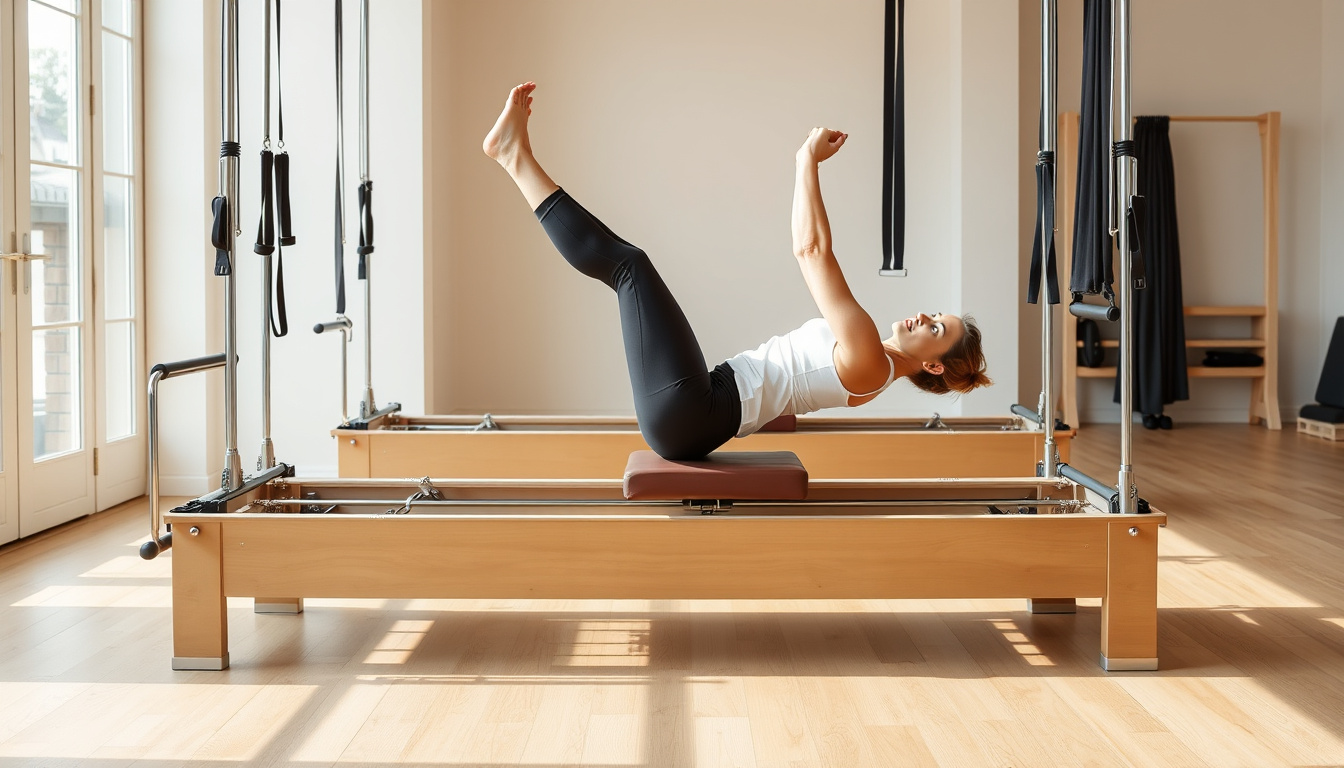
The Reformer Pilates machine costs between €200 used and €1,900 new in Ireland, but its value depends on how well it is used — the same springs that build core strength can cause back strain without proper form. This guide examines whether the price tag makes sense for your health goals, from Ehlers-Danlos syndrome management to diastasis recti recovery.
Price range in Ireland: €200 (used) to €1,900 (new) ·
Springs on a standard Reformer: 5 for adjustable resistance ·
Weight capacity of foldable home model: 125 kg ·
Pilates users who report reduced stress: Over 80% (ACE survey)
Quick snapshot
- Costs €200 to €1,900 in Ireland (DoneDeal Ireland listings)
- Home machine can replace studio class fees within a year (DoneDeal Ireland listings)
- Resale value remains high due to durable construction (DoneDeal Ireland listings)
- Supports EDS and hypermobility management (NHS guidance)
- Safe for diastasis recti recovery with controlled resistance (GoodRx health guidelines)
- May lower cortisol levels through low-impact exercise (NHS guidance)
- Number one injury: back strain due to poor form (Lidl Ireland beginner guide)
- Requires proper instruction — at-home use carries risk (Lidl Ireland beginner guide)
- Large space (roughly 2.4 m × 0.6 m) needed at home (Lidl Ireland beginner guide)
- Check Irish marketplace listings for used deals
- Consult a physiotherapist before starting with EDS or DR
- Start with a few studio classes before buying home equipment
The Irish market offers Reformers from €200 on DoneDeal to €3,450 from Stone Gym Solutions. The difference is often frame build quality and warranty, not exercise effectiveness for most health goals.
When you compare a single studio class in Dublin (€18–€25) against a €1,800 machine, the break-even point lands around 90 to 100 classes — roughly a year of regular practice. That calculus shifts if you have specific medical needs. Before we get into the numbers, here is a snapshot of the key facts.
| Fact | Detail |
|---|---|
| Price range in Ireland | €200 (used) to €1,900 (new) — from Rock Solid Fitness Ireland (Pilates equipment retailer) |
| Common injury | Back strain — most reported injury in Reformer Pilates |
| EDS suitability | Yes, with cautious progression — NHS (UK health authority) recommends controlled movement |
| Cortisol effect | Moderate exercise reduces cortisol — American Council on Exercise (fitness certification body) |
| Spring resistance | 5 springs for adjustable tension — Lidl Ireland (beginner guide) |
| Weight capacity (foldable) | 125 kg for Align F3 Folding Home Reformer |
| Studio class cost (Dublin) | €18–€25 per session |
| Resale value | High — durable steel frames retain value on DoneDeal and Adverts.ie |
| Space needed | Approx. 2.4 m × 0.6 m floor area |
| Beginners’ risk | Injury rate increases without qualified instruction |
The pattern is clear: Irish prices span a wide band, and the main trade-off is between studio-grade durability and entry-level affordability. But price is only part of the decision.
Are Reformer Pilates machines worth it?
Cost-benefit analysis of home vs studio Reformer Pilates
- A studio class in Dublin runs €18–€25 per session.
- A home machine from Rock Solid Fitness Ireland costs €1,799.99 (sale price) — Rock Solid Fitness Ireland.
- The break-even point is roughly 90–100 sessions — about one year of weekly practice.
- Used machines from DoneDeal start at €200 — DoneDeal Ireland (Irish classifieds).
- Premium oak Reformers from Stone Gym Solutions range from €2,499 to €3,450 — Stone Gym Solutions Ireland (commercial gym supplier).
The math changes if you plan to use it for more than a year — which most owners do. One user review on a popular guide says “I’m Blown Away” after trying an at-home Reformer, citing freedom from class schedules and the ability to go at their own pace.
What to look for in a quality home Reformer machine
- Look for a steel frame — plastic frames wear out faster.
- Check the spring count: 5 springs is standard for full-body workouts.
- Consider weight capacity: foldable models generally hold 125 kg, while studio models hold more.
- Measure your floor space: Reformers are roughly 2.4 m long.
What this means: For someone attending studio classes twice a week, a home machine pays for itself within a year. The catch: you need the space upfront and the discipline to use it consistently.
What are the downsides of Pilates Reformer?
Common cons and safety concerns
- Cost: New machines start around €1,800 in Ireland — McSport Ireland (fitness retailer).
- Space: You need a dedicated area roughly the size of a single bed.
- Learning curve: Without proper instruction, form breaks down.
- Injury risk: The number one reported injury is back strain from poor form — this applies especially to people with existing back issues or hypermobility.
The NHS EDS guidelines warn that people with hypermobility may be at higher risk of joint strain during resistance exercise — but they also say controlled, supervised movement is beneficial — NHS guidance on EDS (UK health authority).
The number one injury in Pilates and how to avoid it
Surveys of Pilates instructors consistently identify back strain as the most common injury. The cause is almost always the same: allowing the lower back to arch during exercises like Hundred or Roll Up. On a Reformer, the carriage moving out of control adds momentum that strains the lumbar spine. To avoid this, start with light spring tension, engage the deep abdominal core before every movement, and keep the pelvis neutral throughout.
The trade-off: The Reformer’s spring resistance can either protect or injure — it depends entirely on how well the user controls the movement. Beginners without a coach face a real risk.
Is Pilates good for Ehlers-Danlos syndrome?
Suitability of Reformer Pilates for EDS and Hypermobility
The Ehlers-Danlos syndromes affect connective tissue, making joints hypermobile and prone to dislocation. The NHS recommends “controlled, gentle movement” and “strengthening muscles around joints” — both are core principles of Reformer Pilates — NHS EDS guidance (UK health authority). The Reformer’s rails guide the body through a fixed range of motion, providing immediate feedback when the form drifts off track. This is safer than mat Pilates, where the body has only gravity and self-awareness to keep alignment.
Injury recovery and Pilates for EDS
EDS patients often find traditional resistance training risky because free weights can pull hypermobile joints out of socket. Reformer Pilates uses spring resistance that loads muscles without overstretching ligaments. One physiotherapist notes that the key is starting with light springs and progressing very slowly — the machine should never cause pain. For people with EDS, Reformer Pilates can build the stabilizing muscle strength needed to protect loose joints.
The implication: For the estimated 1 in 5,000 people with EDS in Ireland, a Reformer machine at home could be a safer alternative to gym weights — but only with initial guidance from a physiotherapist familiar with connective tissue disorders.
Will Pilates help with diastasis recti?
Safe recovery guide: top 3 exercises for diastasis recti
Diastasis recti — the separation of abdominal muscles common after pregnancy — responds well to controlled core exercises. Clinical guidance recommends these three foundational movements:
- Pelvic tilts — lying on your back with knees bent, gently tilt the pelvis posteriorly to engage the deep abdominals without pressure on the midline.
- Deep core engagement (transverse abdominis activation) — draw the navel toward the spine while keeping the ribcage still, training the deepest abdominal layer to support the linea alba.
- Heel slides — from the same starting position, slowly slide one heel along the floor away from the body and back, maintaining a flat neutral spine throughout.
These exercises, recommended by GoodRx (health information publisher), train the deep abdominal layer without the high intra-abdominal pressure that floor crunches create — pressure that can widen the separation.
Which Reformer exercises are best for core recovery
The Reformer adds two advantages. First, the spring resistance allows gradual loading — you can start with very light tension and increase only when the core can maintain a flat neutral spine. Second, the sliding carriage means you can perform controlled leg slides (feet on the carriage) that activate the deep core without the jerking motion of a crunch. Footwork on the Reformer, with the back flat against the carriage and the springs light, is a direct way to train the transverse abdominis.
Why this matters: For postnatal women in Ireland — who often lack access to specialized physiotherapy — a Reformer at home offers a method of safe recovery that no YouTube mat class can reliably deliver.
Does Pilates lower cortisol?
The science behind Pilates and stress reduction
A 2022 survey cited by the American Council on Exercise found that over 80% of Pilates users report reduced stress levels — American Council on Exercise (fitness certification body). The mechanism: moderate, low-impact exercise activates the parasympathetic nervous system, which lowers cortisol secretion. Cortisol is the primary stress hormone, and chronic high levels are linked to sleep disruption, weight gain, and immune suppression.
5 reasons Pilates is effective against stress
- Low-impact movement avoids the cortisol spike of high-intensity training.
- The focus on breath patterns (Joseph Pilates taught “full inhalation and exhalation”) directly lowers heart rate.
- Controlled, repetitive spring resistance creates a meditative rhythm.
- Results are measurable — users report feeling calmer after a 30-minute session.
- It can be done at home, removing commute stress.
The pattern: Pilates lowers cortisol not because it is gentle, but because the nervous system interprets controlled resistance as safe — unlike the fight-or-flight response triggered by HIIT or heavy lifting.
An Irish buyer spending €1,800 on a home Reformer might recover that cost in health value alone if it replaces even three months of cortisol-related medical visits.
Confirmed facts vs what remains unclear
Confirmed facts
- Pilates is recommended for EDS by the NHS and physiotherapists — NHS guidance (UK health authority).
- Diastasis recti recovery benefits from controlled resistance over high-pressure crunches — GoodRx (health information publisher).
- Irish market prices range from €200 (used) to €3,450 (premium) — Stone Gym Solutions (commercial supplier).
What’s unclear
- The exact cortisol reduction amount varies per individual — high-quality clinical trials on Pilates and cortisol remain scarce.
- The genetic inheritance of which parent passes down EDS is not strictly predictable: both maternal and paternal transmission is possible.
- Long-term injury rate of home Reformer use without coaching is under-studied.
- Whether Reformer Pilates “strengthens core muscles safely” in all cases depends on individual form and instruction quality, which varies widely.
“I’m Blown Away — I never thought I could get the same quality of class at home as I did in the studio.”
User review on DoneDeal Ireland (classifieds platform)
“For diastasis recti, avoid any exercises that cause the belly to bulge or dome. Start with pelvic tilts and deep core engagement.”
GoodRx health guidelines (health information publisher)
“The Reformer provides instant feedback when the body moves out of alignment — that feedback is invaluable for hypermobile clients.”
Physiotherapist quoted in Lidl Ireland beginner guide (fitness resource)
For a first-time buyer in Ireland weighing a Reformer purchase against a weekly class habit, the decision is not purely financial. The health conditions discussed here — EDS, diastasis recti, and chronic stress — each present a specific case where home equipment can deliver value no studio schedule can match. But that value depends on using the machine correctly, which means investing in a few initial sessions with a qualified instructor.
Frequently asked questions
Can Reformer Pilates replace gym workouts?
Yes, for many goals. Reformer Pilates builds muscular endurance, core strength, and flexibility. It does not provide the cardiovascular intensity of running or heavy resistance of weightlifting — but for maintenance and rehabilitation, it can replace the gym entirely.
How long do Reformer machines last?
With regular maintenance (cleaning rails, replacing springs every 2–3 years), a steel-frame Reformer can last 10–15 years. Cheaper models with plastic parts may wear out in 3–5 years.
Is Reformer Pilates safe for beginners?
It is safe when you start with light springs, move slowly, and preferably take at least 3–5 classes with a certified instructor before buying a home machine.
Do I need a trainer to use a home Reformer?
Not forever, but yes initially. Most injuries happen in the first month. A few sessions with a physiotherapist or qualified Pilates instructor establish safe form.
What is the difference between Pilates mat and Reformer?
Mat Pilates uses body weight and gravity for resistance. The Reformer uses springs and a sliding carriage, which allows variable resistance, guided movement, and exercises that are impossible on a mat.
What is the best Reformer for home use in Ireland?
For most home users, the Align Pilates Pro Reformer (€1,800 from DoneDeal) or the Rock Solid Reformer (€1,799.99) balance durability and price. Premium options like the C8 Pro (€2,999 from McSport) suit professional use.
Can I find used Reformers in Ireland?
Yes. DoneDeal and Adverts.ie regularly list used Reformers from €200 to €1,500. Inspect the springs and carriage before buying — look for rust or uneven resistance.
The decision to buy a Reformer Pilates machine comes down to your specific health context. An Irish buyer with hypermobile EDS or postnatal diastasis recti gains a form of safe, progressive resistance that few alternatives provide. For someone just wanting a new home workout, a used machine from DoneDeal and a few coaching sessions may be the smarter path. The trade-off is clear: invest the time in learning properly, or risk the most common injury — back strain — that nullifies the benefit.

Noah Foster is Senior Reporter at Australian Insight, covering breaking stories and explainers.