
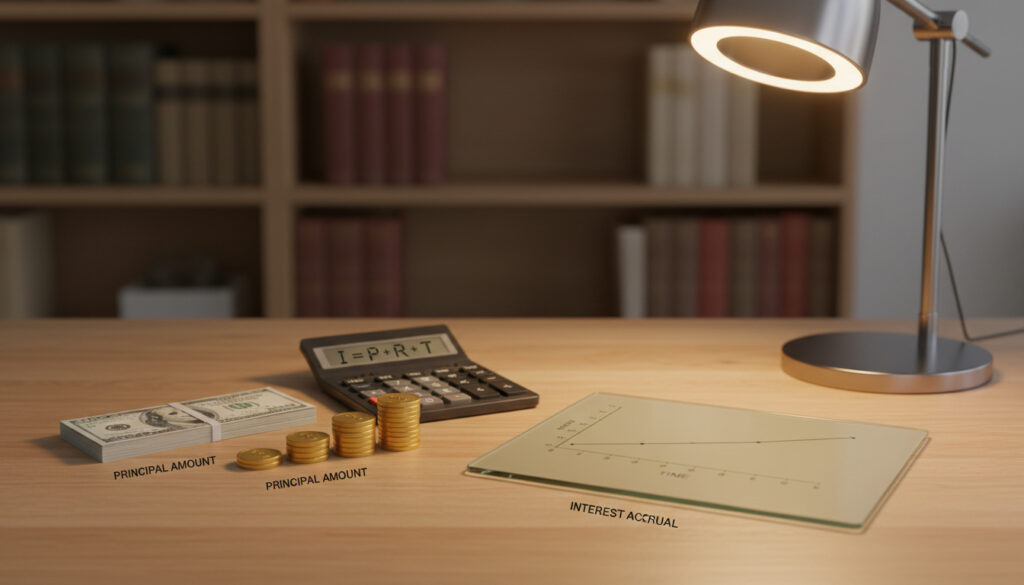
The simple interest formula provides a straightforward way to calculate interest on loans or investments without compounding. It multiplies the principal by the rate and time to determine the interest earned or owed.
This method applies mainly to short-term scenarios, offering transparency since interest accrues only on the initial amount. Borrowers and lenders use it for quick computations in personal finance.
Understanding the formula helps compare options like car loans or bonds, where simplicity trumps exponential growth.
What Is the Simple Interest Formula?
| Core Element | Description |
|---|---|
| Formula | I = P × r × t |
| Key Variables | P (Principal), r (Rate), t (Time) |
| Common Use | Short-term loans |
| Total Amount | A = P + I |
- Interest grows linearly, without reinvestment of earnings.
- Rate converts from percentage to decimal, like 5% to 0.05.
- Time measures in years, with fractions for shorter periods.
- Total repayment formula simplifies to A = P(1 + rt).
- Suitable for transparent, predictable calculations.
- Differs from percentage-based variants like SI = (P × R × T)/100.
- Used in business math for basic lending.
| Variable | Definition | Example |
|---|---|---|
| P | Initial borrowed or invested amount | $3,000 |
| r | Annual interest rate as decimal | 0.05 (5%) |
| t | Duration in years | 2 or 11/12 |
| I | Interest earned or owed | $300 |
| A | Total amount (P + I) | $3,300 |
| SI (alt) | Percentage formula result | $1,680 |
How Do You Calculate Simple Interest?
Start by identifying the principal, converting the annual rate to a decimal, and expressing time in years.
Step-by-Step Calculation
Substitute values into I = Prt. Add the interest to the principal for the total amount A = P(1 + rt).
Some methods use SI = (P × R × T)/100, keeping R as percentage without decimal conversion, as noted in educational resources.
Solving for Principal
Rearrange to P = I / (rt). For I = $2,035 at 6% over 11 months, P ≈ $37,000¹.
Finding the Rate or Time
Use r = I / (Pt) or t = I / (Pr). For A = $26,800 on $22,000 over 4 years, r ≈ 5.45%².
Simple Interest Formula Examples
Basic case: $3,000 at 5% for 2 years yields I = $300, total $3,300³.
Loan Example
$8,000 at 7% for 3 years: SI = (8000 × 7 × 3)/100 = $1,680, total $9,680⁴.
Short-term loans like car or personal from People’s Choice Credit Union often use this for clear repayment.
In banking, it applies to payday advances, charging only on original principal⁵.
Simple Interest vs Compound Interest
| Aspect | Simple Interest | Compound Interest |
|---|---|---|
| Calculation | On original principal (I = Prt) | On principal plus accumulated interest |
| Growth | Linear | Exponential |
| Use Case | Short-term loans/investments | Savings, long-term loans |
Simple yields less over time, favoring borrowers in brief terms⁶.
Check rates influenced by factors like the RBA Cash Rate for Australian loans.
Opt for simple in low-rate, short-duration needs to avoid compounding buildup.
Key Takeaways on the Simple Interest Formula
The formula I = Prt enables precise, linear interest calculations for short-term finance, with rearrangements for any variable. It suits transparent loans over compounding alternatives.
Is simple interest formula used in banking?
Yes, for short-term loans like car or personal, charging only on principal.
When to use simple interest formula?
For short-term scenarios under one year or low rates, avoiding compounding.
What is simple interest formula for loan?
I = Prt on original amount for repayment totals.
How to find principal in simple interest formula?
P = I / (rt), converting time to years.
What is the formula for total amount in simple interest?
A = P + I or P(1 + rt).
Simple interest vs compound interest which is better?
Simple for borrowers short-term; compound for savers long-term.
Real world examples of simple interest?
Bonds, CDs, short bank loans without reinvestment.
Related stories





Liam O'Brien covers Australian politics and public affairs for Australian Insight.